When we look at the history of science, we see that the great majority of the scientists who made discoveries and contributed greatly to the development of science had a strong faith in God. The most striking examples of faith in God giving rise to the development of science, however, are to be found in the history of Islam. Muslim scholars, who grew up with the moral values of Islam and built their whole lives and scientific activity upon the verses of the Qur'an, have rendered very great services to the advanced civilisation that has been attained today.
With the spread of the moral values of Islam, the great majority of Muslim scientists made discoveries that are the foundation of modern science. Indeed, when we look at the history of Islam, we see that science entered the geography of the Middle East together with the moral values of the Qur'an.
First of all, Muslim scientists took as their basis the scientific and technological innovations observed in other states, Rome in the West and, in the East, first and foremost China, and translated important sources. From this body of knowledge they removed what was wrong and inconsistent from the point of view of faith and technique, and made it into something that would benefit them. After this work, by evaluating and interpreting the knowledge they had acquired, they began to serve science and technology.
In the period that began in the 8th century and lasted until the 15th century, Muslim scholars achieved important results in many fields such as the exact sciences, medicine, astronomy, mathematics and chemistry, and in a short time made themselves known to the world in the field of civilisation. In this period, called "the Golden Age of Islam" and "the Islamic Renaissance", Muslim scholars contributed through their discoveries to the development of science in many fields, and thus showed the way to the scholars who came after them. Howard R. Turner said the following about this period in his book Science in Medieval Islam:
"Muslim artists and scientists, princes and labourers together made a unique culture that has directly and indirectly influenced societies on every continent."175
"Bayt al-Hikma (The House of Wisdom)" and the Influence of Muslim Scholars on World History
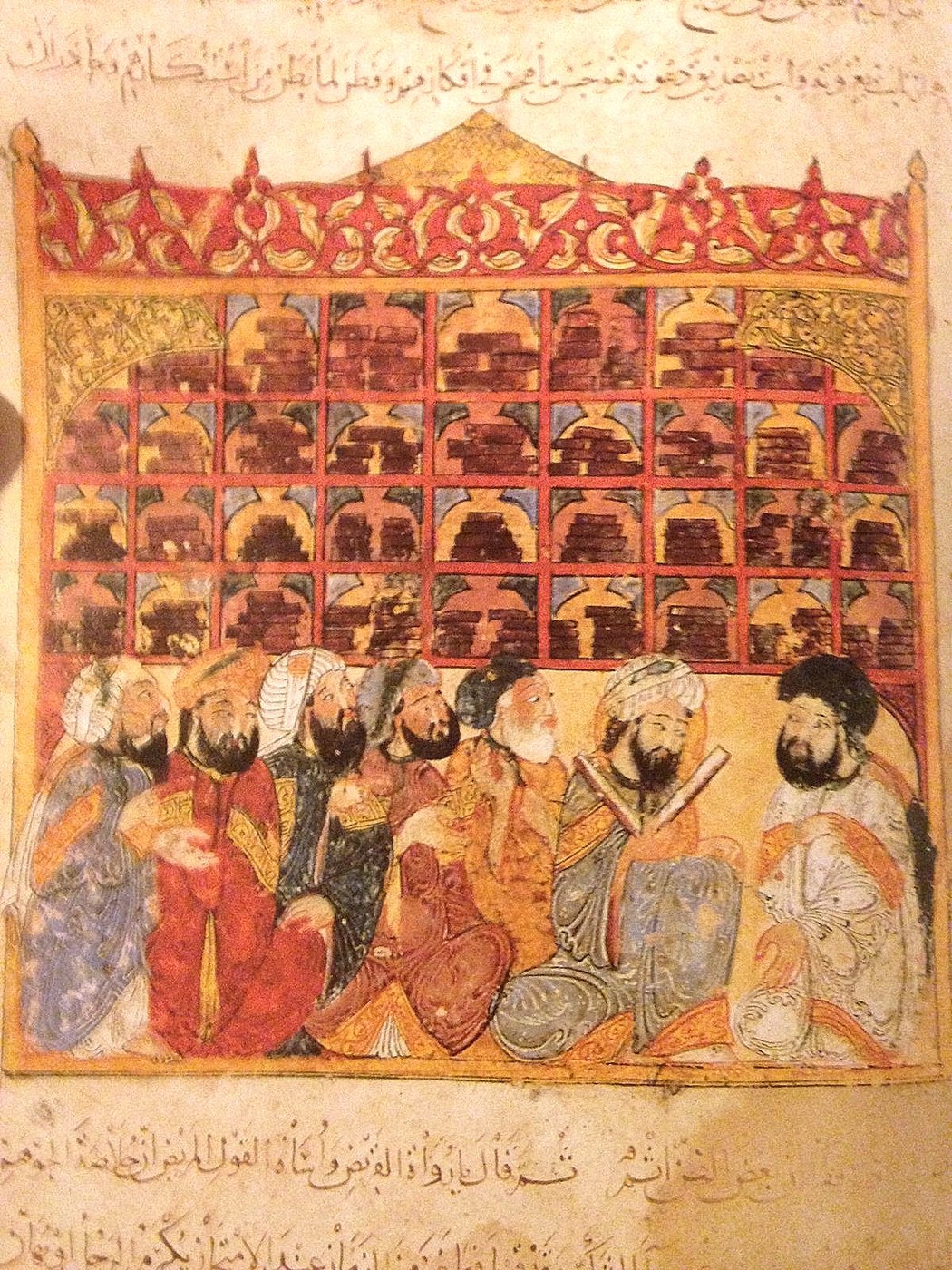
As a result of the conquests they made in the 7th and 8th centuries, the Muslims established a great empire without equal in the world until that day. In the 8th century the Abbasid caliph moved the capital of the empire from Damascus to Baghdad and founded the "Bayt al-Hikma", known in the Western world as the "House of Wisdom". As a result of the activities of Muslim scholars, the "Bayt al-Hikma" became a centre of learning without equal in the world in such fields as science, philosophy, medicine and education. Many scientific works belonging to the civilisations of ancient Rome, China, India, Iraq, Egypt, North Africa, Greece and Byzantium were translated into Arabic at the "Bayt al-Hikma", and Muslim scholars, improving the knowledge in these works, became the founders and practitioners of many of the fields of science of our time. In the history of science these centuries are known as "Arab Science", because throughout this period Arabic was accepted worldwide as the mother tongue of science. In addition, the work in the fields of science and art carried out by Muslim scientists in the Umayyad state of Andalusia, founded in 756 in Andalusia in southern Spain, also made important contributions to the world history of science and art.
As a result of the activities of Muslim scholars, the Bayt al-Hikma became an international centre of learning.
On this subject Robert Briffault wrote the following in his book The Making of Humanity:
"The debt of our science to that of the Arabs does not consist in startling discoveries or revolutionary theories; science owes a great deal more to Arab culture, it owes its existence. The ancient world was, as we saw, pre-scientific. The astronomy and mathematics of the Greeks were a foreign importation never thoroughly acclimatized in Greek culture. The Greeks systematized, generalized and theorized, but the patient ways of investigation, the accumulation of positive knowledge, the minute methods of science, detailed and prolonged observation and experimental inquiry were altogether alien to the Greek temperament... What we call science arose in Europe as a result of a new spirit of inquiry, of new methods of investigation, of the method of experiment, observation, measurement, of the development of mathematics in a form unknown to the Greeks. That spirit and those methods were introduced into the European world by the Arabs."176
In another section of the same book Briffault also put into words the contribution of Islamic civilisation to Europe as follows:
"Science is the most momentous contribution of Arab civilization to the modern world, but its fruits were slow in ripening. Not until long after Moorish culture had sunk back into darkness did the giant to which it had given birth rise in his might. It was not science only which brought Europe back to life. The light brought by Islamic civilisation illuminated the life of the Europeans anew."177
George Sarton, regarded as one of the founders of the history of science, expressed the services of the Muslims to the history of science with the words "The main achievement of the Middle Ages was the creation of the experimental spirit, and this was primarily due to the Muslims down to the 12th century".178 Oliver Joseph Lodge, in his work Pioneers of Science, wrote the following concerning the vital roles that the Arabs took upon themselves in the history of science after the spread of Islam:
"The only effective link between the old and the new science is afforded by the Arabs. The dark ages come as an utter gap in the scientific history of Europe, and for more than a thousand years there was not a scientific man of note except in Arabia."179
Some of the Muslim scientists who turned to science in the light of the Qur'an and achieved successes that have come down to our time are the following:
Jabir ibn Hayyan (721-805)
Jabir ibn Hayyan, called "Geber" in the Western scientific world and one of the best-known Muslim scholars, is accepted by everyone in the Western scientific world as "the father and founder of chemistry".180 Indeed, the word "alchemy", the English counterpart of the word chemistry, also derived, as a result of Jabir ibn Hayyan's work, from the Arabic word "al-kimiya".
Jabir ibn Hayyan, known as the father of chemistry.
Jabir ibn Hayyan is the scientist who first said, 1000 years before the atomic bomb was made, that the atom could be split and that, as a result, a great force would come into being. Hayyan's words on this subject are as follows:
"In 'juz' la yatajazza'" (the atom), the smallest part of matter, there is a great deal of energy. It cannot be said that it cannot be split, as the Greek scholars claim. It too can be split. And when it is split, such a force (energy) comes into being that it could turn Baghdad upside down. This is a sign of the might of God Most High."181
Jabir ibn Hayyan helped the science of chemistry achieve great progress both in the theoretical and in the practical field. He went down in history as the scholar who founded the first chemistry laboratory in the world. He explained the synthesis of important chemical substances and, identifying many chemical substances, gave them the Arabic names used in our time.182 By making the sensitive measuring instruments used in the science of chemistry, he introduced into chemistry such chemical methods as crystallisation, distillation, calcination and sublimation.183 As well as many acids such as sulphuric acid and nitric acid, he also discovered sodium carbonate and potassium.184 By producing paper that does not burn in flame, he made many discoveries in such fields as making various metals fit for use, improving steel, varnishing waterproof cloth, gilding to prevent rust, and obtaining dyes and oils.185 Jabir ibn Hayyan was active not only in chemistry but also in such fields of science as medicine, astronomy, logic, philosophy, physics and mechanics, and wrote works on them. It is known that Jabir ibn Hayyan wrote about 200-500 works in such fields of science as medicine, physics, astronomy and philosophy, and first and foremost chemistry. However, many of these works were later lost; only 27 of them were printed in Latin and German in Nuremberg, Frankfurt and Strasbourg between 1473 and 1710.
Al-Khwarizmi (780-850)
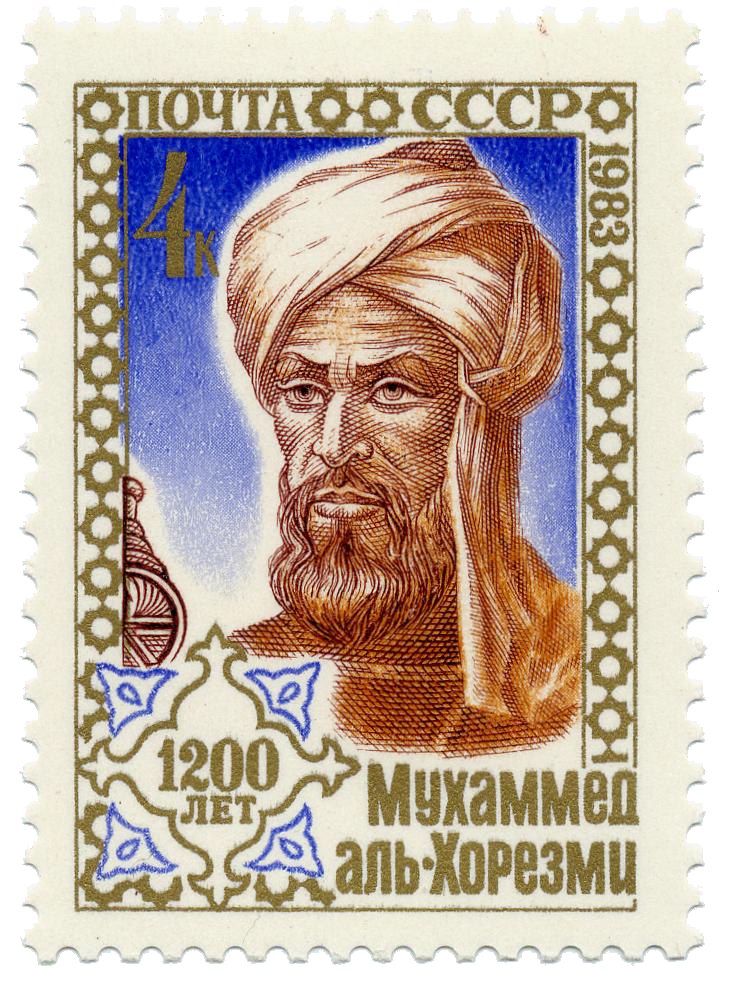
Abu Abdullah Muhammad ibn Musa al-Khwarizmi, one of the greatest scholars of his time, is a mathematician, astronomer and geographer who left deep marks on the Western scientific world. Al-Khwarizmi spent a large part of his life at the "Bayt al-Hikma" in Baghdad. He was the Islamic scholar who founded the sciences of algebra and the algorithm and gave these sciences their names.186 Because al-Khwarizmi's name was pronounced in Latin in Europe as "Algorismi", the method he found was given the name "algorithm".187 Al-Khwarizmi is the author of "Kitab al-Mukhtasar fi Hisab al-Jabr wa'l-Muqabala" ("The Compendious Book on Calculation by Completion and Balancing"), the first work in the field of algebra. The work begins with this sentence:
"Algorismi says: praise and glory be to God, our Lord and Protector." Al-Khwarizmi is the first person in the scientific world of the East to write a work on the science of algebra. This field of science had previously been very little developed and had begun to be regarded as a science different from geometry. The solution of equations of the first degree had become possible, but the roots of equations of the second degree still remained obscure. Al-Khwarizmi, with his second book "al-Jabr wa'l-Muqabala", is the first person to show systematically the way to solve equations of the second degree. Al-Khwarizmi explained the methods he set out in his work with a teacher's talent and proved these rules geometrically.
Abu Abdullah Muhammad ibn Musa al-Khwarizmi, who left deep marks on the Western scientific world through his work in such fields of science as astronomy, mathematics and geography.
In this book, the original of which is kept at Oxford University, he explained the decimal number system for the first time in the world and, moreover, for the first time showed ways of solving problems by the method of setting up equations. In addition, many new terms not previously known were used in this book: such as the square root, odd, and odd number.188 This work of al-Khwarizmi marked the beginning of a very important advance from the point of view of the history of mathematics, and for more than 600 years it was regarded as the foundation for the teaching of mathematics. Scholars such as Roger Bacon and Fibonacci studied his work with admiration and made use of it in their own lessons. Until the end of the 1500s (1598-1599) the only source in the science of algebra was this work of al-Khwarizmi.
Al-Khwarizmi, who worked in various observatories alongside mathematics, also wrote works in the sciences of astronomy and geography. He has works on sundials and clocks.189 Al-Khwarizmi also measured the length of one degree of meridian of the globe.
Thabit ibn Qurra (821-901)
Thabit ibn Qurra is one of the Islamic scholars who were specialists in the fields of mathematics, astronomy and medicine. In his time he brought about very great progress in all these fields, and in particular achieved innovations in the field of geometry and algebra.190 George Rivoire, one of the scholars studying Eastern civilisations, explained Thabit ibn Qurra's contributions to the science of geometry with the words "We owe the application of algebra to geometry to the Muslims. And this is the work of Thabit ibn Qurra, who died in 900."
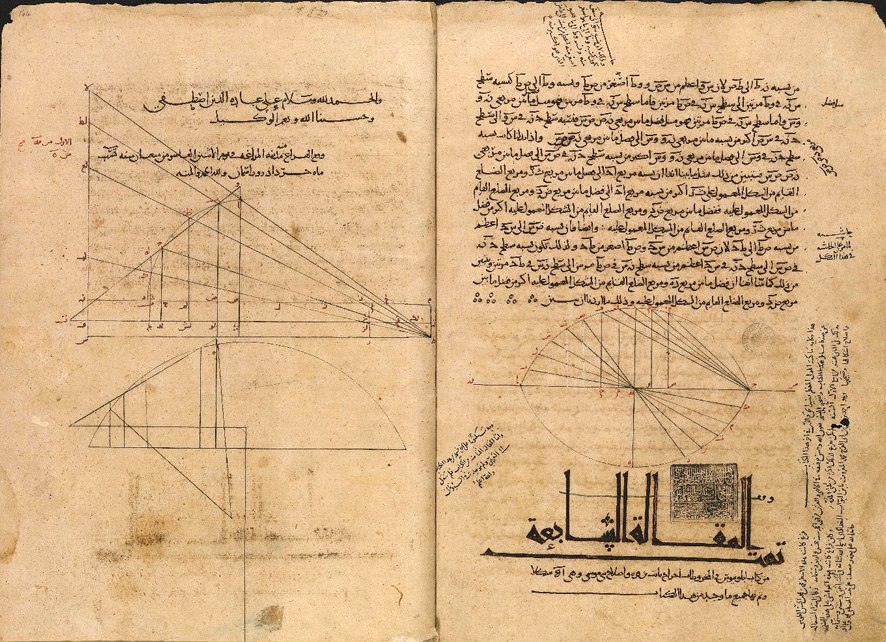
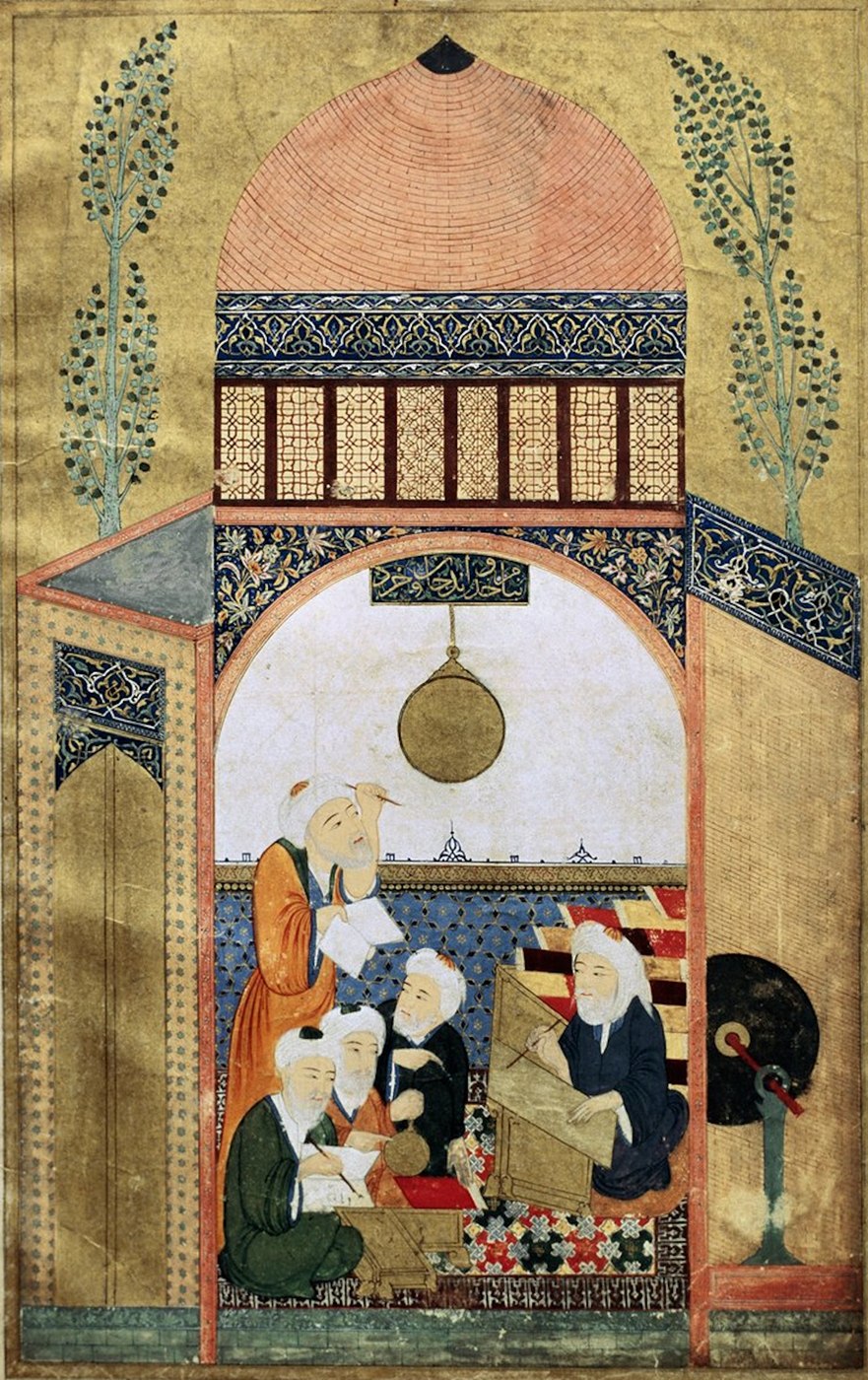
This manuscript work, kept in the archive of the Kandilli Observatory, sheds light on the activities of Muslim scholars in the field of astrology.Muslim scholars achieved considerable work in many fields.
It is known that Thabit ibn Qurra, who was interested in mathematics, astronomy, astrology, medicine and translation, has 79 works. Of these, 21 concern medicine, 2 music, and the remaining 25 works mathematics and philosophy.
Thabit ibn Qurra discovered the sine theorem and applied it to astronomy. In addition, he gave a general proof of the Pythagorean theorem.191 He is the Islamic scholar who, taking the circumference of the earth as divided into 360 meridians, calculated the length of the equator and, in connection with this, found the radius of the Earth.192 Making use of Euclid's knowledge, Thabit ibn Qurra began to show the solution of more general formulae in the field of algebra. Carl B. Boyer said the following about this skilful mathematician in his book A History of Mathematics:
"The 9th century AD was the golden age of Muslim mathematicians. The first half of the century bore the stamp of al-Khwarizmi, the second half that of Thabit ibn Qurra. Al-Khwarizmi and Euclid resemble each other as 'founders'. Thabit ibn Qurra, on the other hand, is, like Pappus, a commentator on higher mathematics."193
Al-Farghani (9th century)
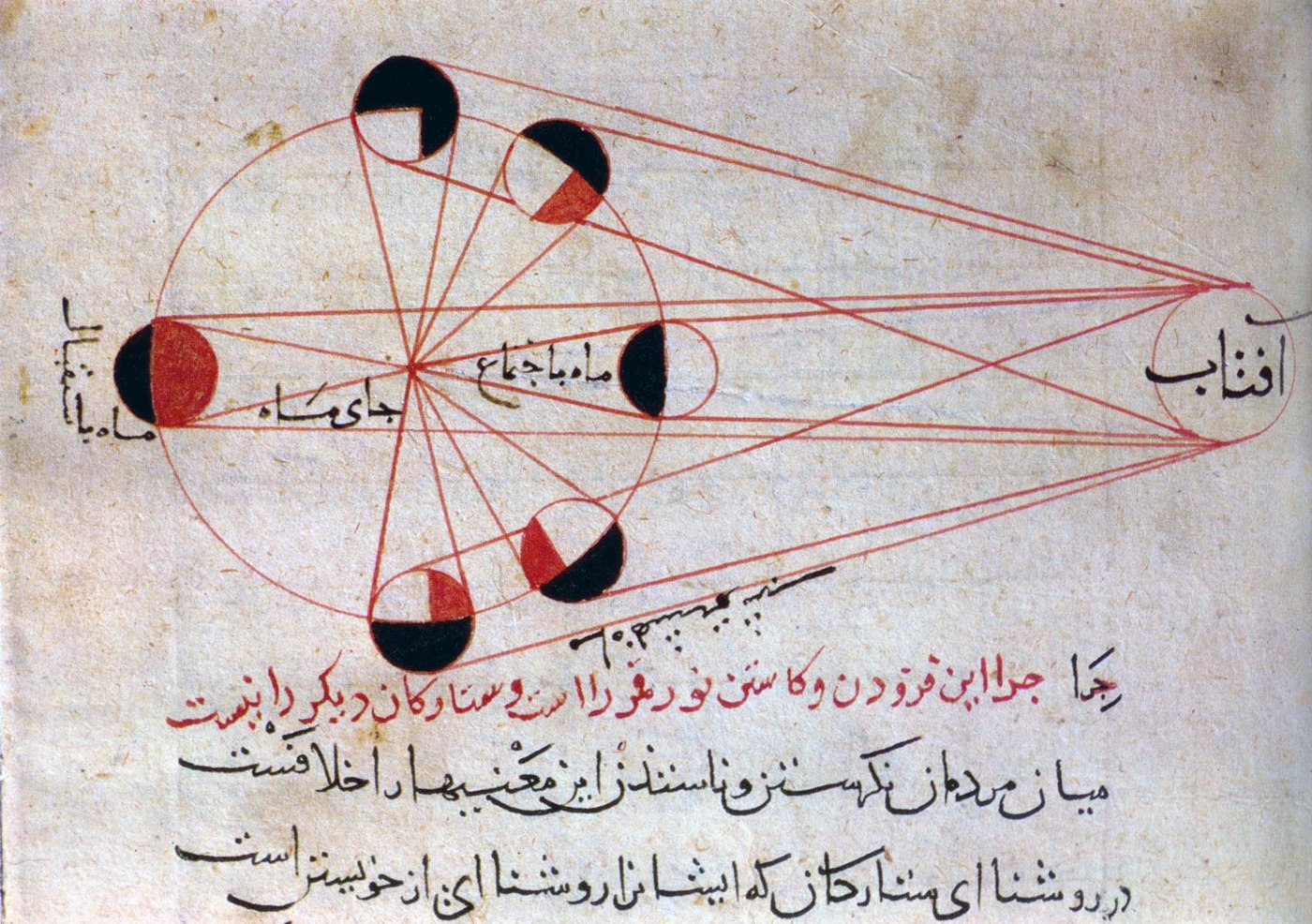
He is the great scholar of astronomy and mathematics who lived in the ninth century and discovered the obliquity of the ecliptic and that the Sun too moves. Al-Farghani, who was from the Fergana region of Turkestan, carried out experiment-based research in the fields of astronomy, mathematics, geography and mechanics.194 He studied the movements of the heavenly bodies and carried out research on them. He wrote commentaries that caused a stir concerning the accepted claims of Ptolemy in the science of astronomy. He investigated the size of the universe and of the planets and the distances between them. The calculations he made as a result of his research were accepted in Western astronomy as unchanging measurements until Copernicus and were used for hundreds of years.
As a result of al-Farghani's research it was revealed for the first time that the Sun too has an orbit and rotates about its own axis from west to east. In addition, as a result of astronomical research lasting 41 years, the distance between the circles of latitude was also determined.195 One of al-Farghani's most striking achievements is the method he discovered for determining solar eclipses in advance. In 842 al-Farghani determined a solar eclipse in advance with this method.196 The most important of al-Farghani's 6 works on astronomy that have come down to our time is "Jawami' Ilm al-Nujum wa'l-Harakat al-Samawiyya" ("The Principles of Astronomy and of the Movements of the Heavenly Bodies"). Manuscript copies of this astronomy book concerning the movement of the heavenly bodies are kept in Oxford, Paris, Cairo and the library of Princeton University in America.
His work in the fields of astronomy, mathematics, geography and mechanics led to the development of these fields of science and the strengthening of their foundations. The influence of al-Farghani can be seen in the works of all the scholars of Turkestan of that period and of European scientists. His works, translated into Latin, were used for centuries as textbooks in European universities. The value al-Farghani, known in the Western world by the name "Alfraganus", found for the circumference of the Earth (about 40,253,700 metres) played an encouraging role in Christopher Columbus putting into practice his idea of reaching India by crossing the Atlantic Ocean. Columbus says on this subject:
"During my voyages I carefully observed the route from Lisbon to Guinea, and for each degree I found the value of Alfraganus, 56 2/3 miles. We must trust this measurement."197
Al-Battani (859-929)
The scholar of mathematics, astronomy and geography al-Battani made many important discoveries, especially in the field of astronomy. Al-Battani, known in the West as "Albategnius", is even today accepted as one of the 20 most famous astronomers in the world. In the observatory he founded in 877, al-Battani studied the movements of the Sun, the Moon and the planets, and collected all these observations in the astronomical catalogue called "Zij al-Sabi". This catalogue is the largest and most comprehensive work written on this subject.
The famous astronomer calculated the obliquity of the Earth's ecliptic, which Copernicus, who lived five centuries after him, calculated as 23° 35', as 23°, and succeeded in determining the angle value known in our time with a difference of half a minute. In addition, he found that a solar year consists of 365 days, 5 hours, 46 minutes and 24 seconds. This discovery is extremely close to the calculations of our time. He also discovered that the longitude of the Sun's apogee had increased by 16° 47' since Ptolemy's discovery. This result is an important discovery showing the orbital movements of the Sun and that small differences occur in the equation of time.
Al-Battani is one of the greatest astronomers and mathematicians of his time.
In the field of mathematics he is the first person to use sines instead of the Greek chords. Al-Battani, accepted as the true founder of the new trigonometry, specialised in his work in the field of spherical trigonometry and, by studying right angles, set out the concepts of sine, cosine, tangent, cotangent, secant and cosecant.198 He has many works on astronomy and trigonometry. His work in the field of astronomy left its mark on Europe until the Renaissance, and his discoveries in astronomy and trigonometry helped the development of these sciences.199 Al-Battani, regarded as one of the first Muslim scholars whose works were translated into Latin, built the true aim of his scientific work on this foundation:
"Man can learn the existence, oneness and might of God and the perfection of His works through the sciences, first and foremost astronomy. For example, these visible stars, this Earth on which we live and the movements of the Earth are clear proof of the existence and oneness of God."200
Abu al-Qasim al-Zahrawi (936-1013)
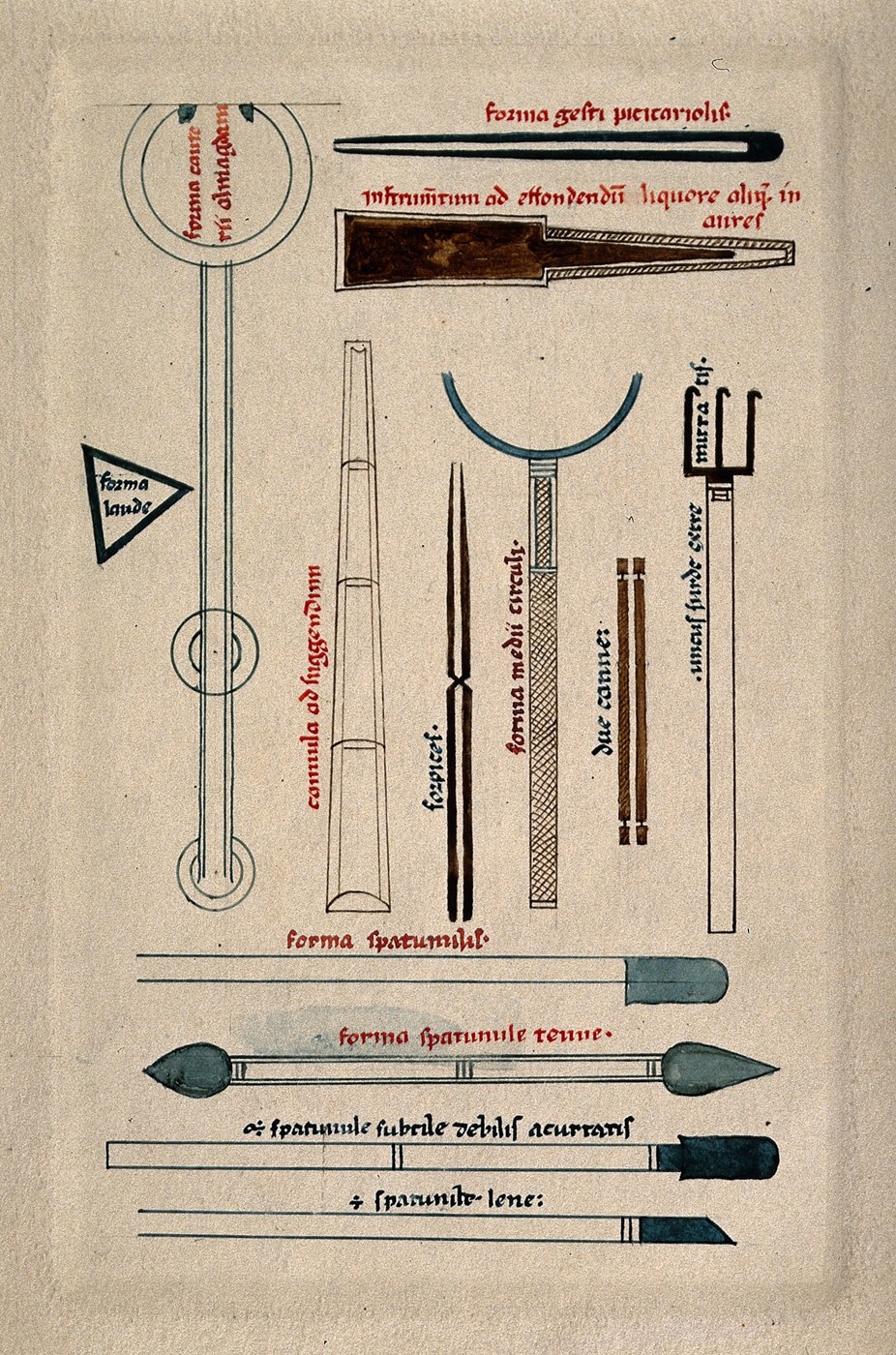
It was thanks to al-Zahrawi of Andalusia that surgery became an independent science. Al-Zahrawi performed surgical operations that others before his time had been unable to perform, and invented methods and instruments. Al-Zahrawi is regarded as the physician of that time who engaged most extensively and most seriously in the science of medicine. The most important factor that helped spread his fame was his famous work "al-Tasrif". This book, consisting of two volumes and thirty sections, is a work of nine hundred pages, and its real title is "Kitab al-Tasrif li-man 'Ajiza 'an al-Ta'lif". This work became the standard encyclopaedia used in the West. "Al-Tasrif" is the first book in which, together with descriptions of surgical instruments, pictures of these instruments are also depicted. Many of these surgical instruments, whose number reaches 200, are new instruments that had never before been used in any operation. Some of al-Zahrawi's achievements in the science of medicine are these:
Al-Zahrawi further improved many delicate operations, including the removal of a dead fetus and amputation (the cutting off of limbs).201 He brought together the surgical knowledge of his time and introduced into the medical world new ideas and methods, such as performing operations on live animals for experimentation.
Al-Zahrawi is the physician who first described haemophilia (a serious blood disease in which the level of blood clotting is low) in history.202 He is the first person to treat fractures of the pelvic bone.203 It was also al-Zahrawi who first established how kidney stones are to be removed.
He was the first to make an original instrument called "sanānīr" for cleaning out and removing nasal polyps.
He was the first to perform a hernia operation, and used anaesthesia methods of his own in his operations.
Al-Zahrawi is known as the first physician to put forward the idea that decayed teeth should be filled with lead before being extracted, so that they could be extracted without breaking.
He used the instruments needed during operations after cleansing them of microbes by a method of his own. He carried out this cleansing by means of a substance called "ma' al-safra". Research carried out in our time has shown that this substance has the property of destroying bacteria.
Alongside is shown a page from the Latin translation of al-Zahrawi's work "Kitab al-Tasrif li-man 'Ajiza 'an al-Ta'lif". Al-Zahrawi invented and used very delicate and fine instruments in the field of medicine.
The fact that al-Zahrawi was the first to use animal gut to stitch wounds has been accepted by Western scientists. The catgut fibres in today's modern sterile packs have come down to our time from al-Zahrawi.204 In the opinion of Donald Campbell, "What attracted the attention of European scholars regarding al-Zahrawi was his easy removal of the fetus at birth. His method, overshadowing Galen's method, maintained its superiority in Europe for five hundred years and helped to develop the standards of surgery in Christian Europe."205
Ibn al-Haytham (965-1040)
The greatest Islamic physicist to emerge in the Middle Ages is Ibn al-Haytham. Ibn al-Haytham's work on light entitled "Kitab al-Manazir" (Opticae Thesaurus, The Treasury of Optics) was translated into Latin and influenced the research of physicists such as Roger Bacon in the West. Whereas in ancient times it was thought that vision came about through light leaving the eye and reaching the object, al-Haytham proved, quite the contrary, that light reaches us from the object. Ibn al-Haytham was the first to give a physical explanation of vision. In addition, Ibn al-Haytham, who was a mathematician and philosopher, wrote more than a hundred works and was accepted as a great authority in all the fields of science of his time.206
Al-Biruni (973-1051)
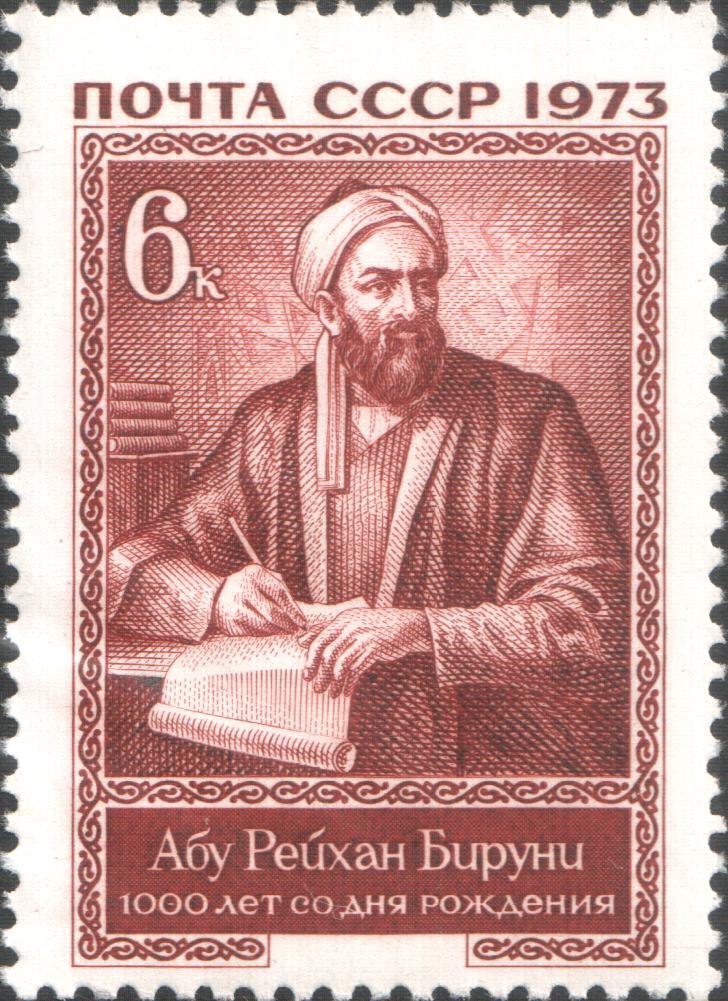
Al-Biruni, regarded in the Islamic world as the greatest scholar of science and religion of the 10th and 11th centuries, was in the world history of science the greatest astronomer, mathematician, ethnographer, historian and philosopher of his time. His works are still used as sources in the Western scientific world today. The UNESCO magazine Courier, published in 25 languages, carried on the cover of its June 1974 issue the words "Al-Biruni, a universal genius who lived in Central Asia 1000 years ago: astronomer, historian, botanist, pharmacologist, geologist, poet, thinker, mathematician, geographer and humanist".
Al-Biruni, who caused the century in which he lived to be called "the age of al-Biruni" and whose works were drawn upon for centuries after his time, left his mark not only on the Islamic world but on the whole world.207 Al-Biruni, who was of Turkish origin, stated that as a result of the Turks accepting Islam and the spread of this civilisation over very wide areas, humanity made great gains, especially in the field of science.
Although it is accepted that the law of gravitation was discovered by the English scientist Newton, the first to carry out research on this subject was al-Biruni. In addition, he voiced nine and a half centuries ago the idea, debated in our time, that the land masses are drifting northwards. Al-Biruni, who in his time was the first to speak of the existence of the Cape of Good Hope, also gave comprehensive information about Northern Asia and Northern Europe, and moreover spoke of the American continent and Japan five centuries before Christopher Columbus.208 He began his work in the field of astronomy in 995 by calculating the inclination of the Sun and the planets. He noted that the speed of light is extremely great compared to that of sound.209 Al-Biruni was the first to set out the relationship known in trigonometry as the cosine theorem, applied geometry to botany, established very original facts about birds and wrote many books in very different fields.
Al-Biruni is one of the greatest scholars of his time in the field of the natural and exact sciences.
He discovered that light is faster than sound. Just as he revealed the differences between hot water and boiling water, he also discovered the expanding effect of heat on metals.210 In his work entitled "Kitab al-Jamahir fi Ma'rifat al-Jawahir" (On the Properties of Precious Stones), he calculated the weights of 23 solids and 6 liquids very close to their present-day values.211 Al-Biruni determined relative densities with an instrument he called the conical instrument, which is regarded as the oldest pycnometer (an instrument for measuring density). In order to show various features of the sky and the earth's surface, the circles of latitude and longitude, and the continents and seas, he made a globe seven metres in diameter. With this work he earned in history the title of the first scholar to map the Earth on a globe.212 His work entitled "Nihayat al-Amakin" (The Limits of Places) covered various fields, from geography to geology and geodesy (the determination of the shape of the globe and the measurement of the earth's surface).213 Al-Biruni's most important work in the field of astronomy is his encyclopaedia entitled "al-Qanun al-Mas'udi" (The Mas'udic Canon). In this work, together with many new discoveries, there is also a section on trigonometry. Al-Biruni, who opposed the rules of Ptolemy and Aristotle and put forward that the Earth is not stationary but a rotating mass, laid, according to historians of science, the foundations of modern astronomy.
Al-Biruni's Faith in God
Al-Biruni met Ibn Sina in the library of Bukhara, and they benefited from each other's knowledge. The scholars of Bukhara had a tradition of sound exchange of knowledge. They would not hide what they knew from others, and loved to share it.214 Al-Biruni cited a verse from the Qur'an in connection with the fields of algebra, geometry and geography, commented on the subject dealt with in the verse, united science and religion, and said that his aim in learning science was to know God and to find the truth. His works are still used as source works in the Western scientific world.
Alongside are shown a few examples of al-Biruni's work.
In his book entitled "The Canon on the Earth and the Stars", al-Biruni proved that the stars and planets are spherical and, by proving that the Earth revolves around the Sun and the Moon around the Earth, explained these truths 6 centuries before Western scientists.215 Al-Biruni, who succeeded in calculating the diameter of the Earth with a famous rule known by his name, found the radius of the Earth with a difference of only 14 kilometres.216 Al-Biruni's book entitled "History of India", which gives very valuable information about India, was translated into all Western languages and became an irreplaceable source for scholars of geography and history. During the period he spent in India, by translating many sources in Arabic into Sanskrit and some books in Sanskrit into Arabic, he built the first cultural bridge between the Islamic and Indian civilisations.217 Al-Biruni carried out scientific work by referring to the wisdom in the verses. God draws attention in many verses of the Qur'an to the importance of the truths of faith. In the verses of Surah Fatir, examples of the truths of faith are given and it is stated as follows:
"Do you not see that God sends down water from the sky and by it We bring forth fruits of varying colours? And in the mountains there are streaks of white and red, of varying shades, and rocks of deep jet black. And mankind and beasts and livestock are likewise of varying colours. Only those of His servants with knowledge have fear of God. God is Almighty, Ever-Forgiving."
Al-Biruni too obtained scientific truths by referring to the wisdom in the verses. For example, he explained with this verse that in the north of the Earth the Sun does not rise for months, and when it does rise it does not set:
"Until he reached the rising of the sun and found it rising on a people to whom We had given no shelter from it."
Al-Biruni demonstrated this by placing a globe representing the Earth in front of a lamp and rotating it.218 Returning the gift of Sultan Mas'ud, who had sent him gold and jewels to the weight of an elephant for his book, al-Biruni said, "I wrote this book not for wealth but for science."219
Ibn Sina (Avicenna) (980-1037)
Ibn Sina, accepted by all the scientific circles in the world as one of the most valuable scholars who have ever lived, had learned all the sciences of his time while still only 18 years old. His work entitled "al-Qanun fi'l-Tibb" (The Canon of Medicine), accepted as a masterpiece of medicine and known briefly as "al-Qanun", is divided into sections on physiology, hygiene (the preservation of health), treatment and pharmacology (the field of science concerning medicines). This work, a great medical encyclopaedia of five volumes consisting of about a million words, guided medical literature for centuries both in its content and in its manner of composition. From the 13th century onwards it was used as a textbook in European universities, and it was also the main textbook at the universities of Montpellier and Louvain, famous medical faculties of the France of that time. Until the emergence of the new medicine after him, it was regarded as the source on which works written in Turkish, Arabic, Persian and various Western languages relied. A large part of the medical knowledge dealt with in "al-Qanun" still preserves its value today.
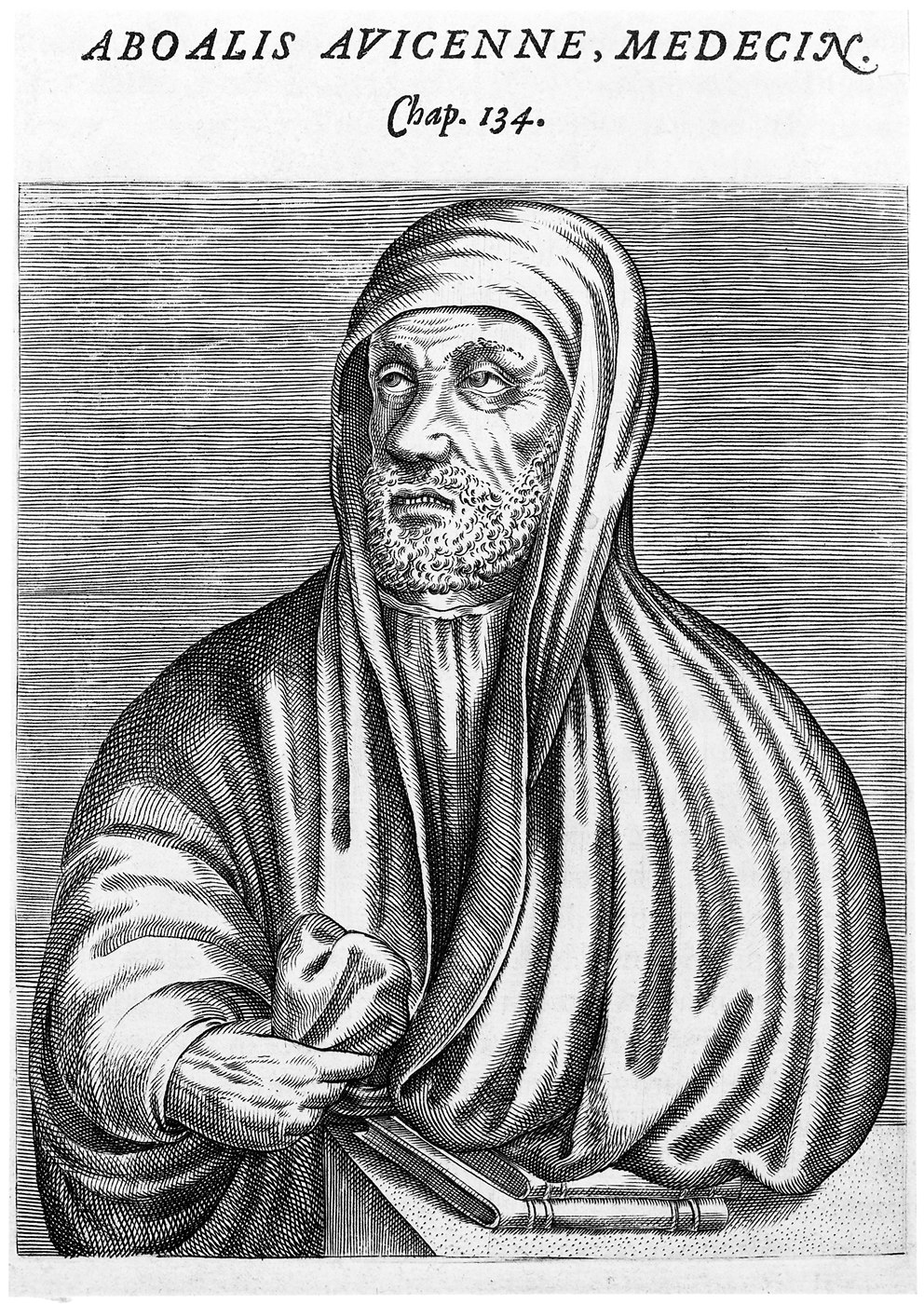
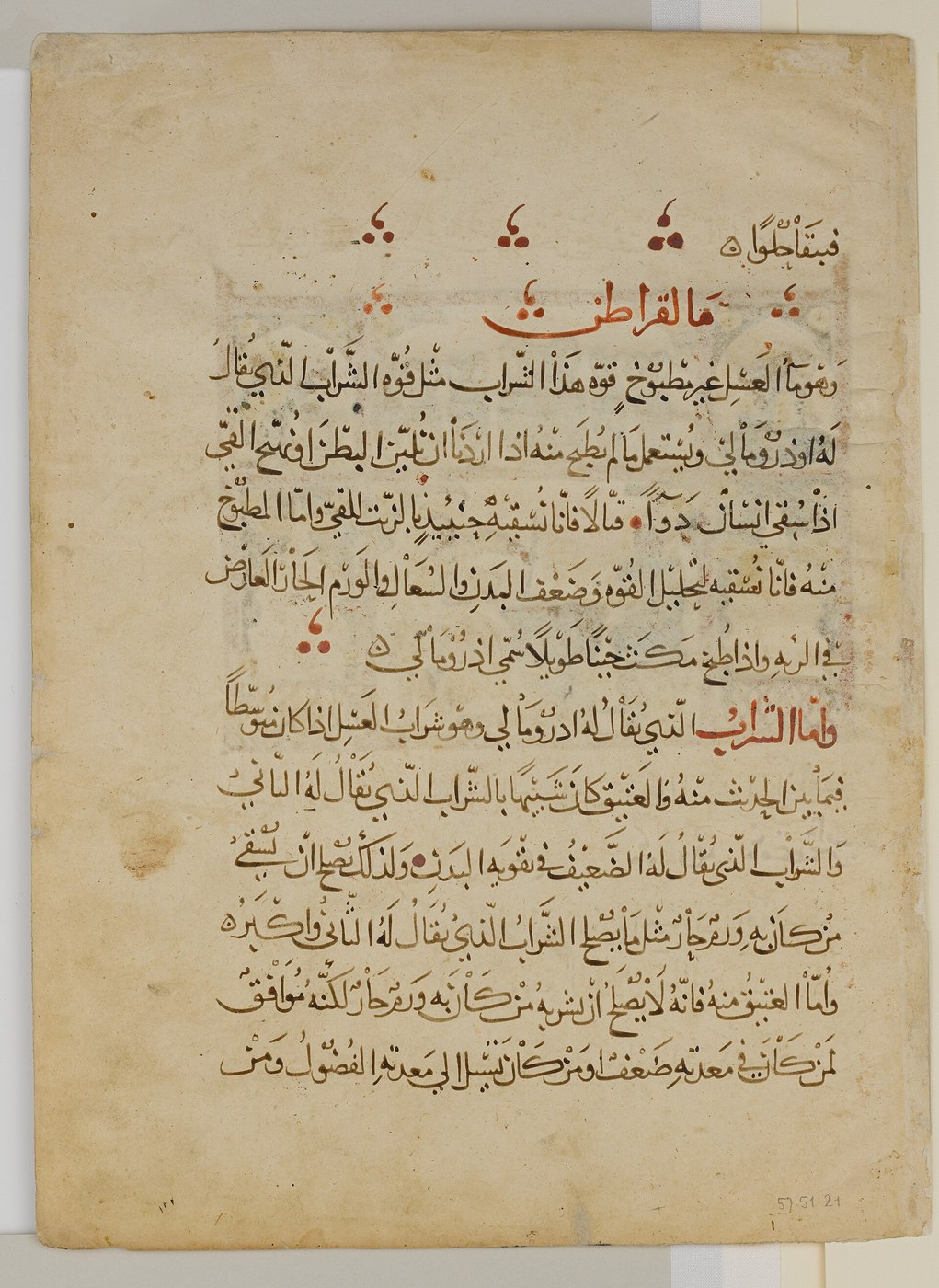
The work of Ibn Sina, known as the great physician, containing his information on the liver, lungs, heart and brain, is shown.On the right is seen a pharmacy miniature in a 15th-century manuscript of Ibn Sina's work. Below is given a picture showing Ibn Sina at work.
With his ideas that shed light on the medicine of our time, Ibn Sina, known in the Western world by the name "Avicenna", was the first in the medical world to separate medicine and surgery as two distinct fields. In addition, he emphasised the importance of anatomy in surgical treatment for a person's healthy life, and, giving examples of surgical treatment not preferred because of very high risk to life, recommended the instruments to be used in operations.
When his works on medicine are studied, it can be seen that Ibn Sina had many ideas that are fundamental even for the medical world of our time. Indeed, in his medical research he spoke in his works of the effects of a kind of being invisible to the eye in the transmission of certain diseases, that is, of the existence of "microbes", these unknown beings. It was the physician Ibn Sina who was the first to give an injection under the skin, the first to apply anaesthesia in operations, who studied diseases of the stomach and intestines scientifically, who determined the effect of psychological states on the digestive system, who first found the causes of facial paralysis, and who first identified stomach and intestinal worms and the respiratory system.220
The Great Physician
Ibn Sina, who carried out extensive research in the fields of mathematics, astronomy and geometry and is accepted as "the Great Physician", wrote nearly 150 works, most of which belong to such fields of science as physics, astronomy and philosophy. The work of Ibn Sina, who explained the first law of physical dynamics 500 years before Isaac Newton in his 18-volume encyclopaedia entitled "al-Shifa", also covers, together with medicine, the fields of mathematics, physics, metaphysics, theology, economics, politics and music.221 In the field of philosophy too, Ibn Sina influenced both Eastern and Western philosophers. His works were translated into Latin in the 12th century and from then on spread throughout the world. Ibn Sina's works occupied the places of honour in the world's libraries for about 8 centuries.222
Al-Khazini (1100-1160)
Al-Khazini, an astronomer and physicist who lived in Turkestan in the 12th century, is known especially for his work on gravity and balances.223 Al-Khazini said, 500 years before Newton, that "there is a force that draws every body towards the centre of the globe".224 A hundred years before Roger Bacon he put forward the idea that water becomes denser as it approaches the centre of the Earth. He is the first person to use the areometer to measure the density and temperature of liquids.225 In addition, he worked on how the qibla should be determined in many Islamic cities. Al-Khazini also studied the principles of the refraction of light and determined that the rays of the sun coming into contact with the sky reach the Earth not directly, in a straight line, but by being refracted.
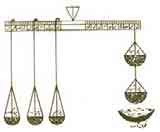
The picture shows the five-pan "balance of wisdom" that al-Khazini made to calculate the weights of bodies in air.
Al-Khazini helped the development of the science of chemistry with the sensitive balances he invented to measure the density and specific gravity of chemical substances. In his work entitled "Kitab Mizan al-Hikma" (The Book of the Balance of Wisdom), he introduced the hydrostatic balance as a measuring instrument. He gave the balance he invented the name "al-mizan al-jami'" (the comprehensive balance). The density and weight calculations he carried out with this balance are very close to the calculations carried out using the technology of our time.226 In his work entitled "Zij al-Sanjari" (Star Catalogue), al-Khazini also included information on the stars and planets and the latitudes and longitudes of the Seljuk state. In his booklet entitled "Risala fi'l-Alat" (Treatise on Instruments), he deals with observational instruments.
Ibn Rushd (1126-1198)
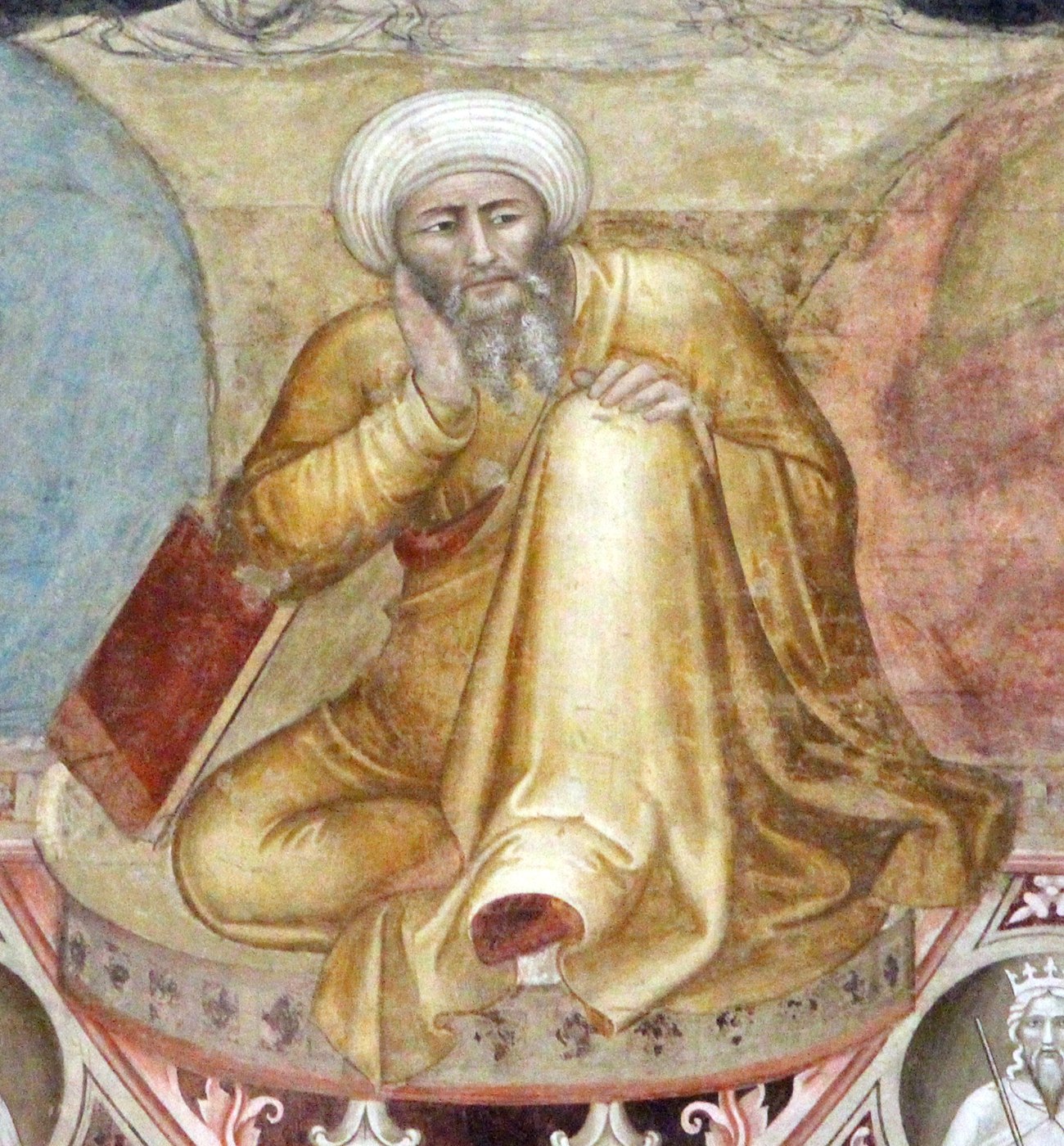
He is the Andalusian scholar of philosophy, Islamic jurisprudence, mathematics and medicine known in the Western world by the name "Averroes". His most famous philosophical work is "Tahafut al-Tahafut" (The Incoherence of the Incoherence). He tried to relate Aristotle's system of thought to Islam. The rediscovery in the West of Aristotle's scientific legacy resulted from the translation of Ibn Rushd's works into Latin at the beginning of the 12th century, and his works influenced Eastern and Western thought for centuries.
Ibn Rushd, scholar of medicine, mathematics, philosophy and Islamic jurisprudence.
His books were printed in Italy in ten volumes and used as textbooks in the universities of both Italy and France.227 Ibn Rushd, who saw the human body as "an extraordinary work of God in terms of its creation",228 said that "dissecting the body into parts for study strengthens faith".229 In the field of neurology, Ibn Rushd put forward the existence of Parkinson's disease and that the photoreceptor properties belong to the retina of the eye.230 In the field of physics, Ibn Rushd is the first person to define and measure force as "the rate at which work is done in changing the kinetic condition of a material body". In addition, it was also Ibn Rushd who first maintained that "the effect and measure of force is the change in the kinetic condition of a materially resistant mass".231
Al-Jazari (1136-1206)
Al-Jazari, described by Western sources as "the Muslim engineer who rose to the summit of his age", was chief engineer for 32 years at the Artuqid palace in Diyarbakir in Eastern Anatolia. Al-Jazari, who carried out scientific work there, is at the same time the first founder of the science of cybernetics, the science of communication, control, balancing and regulation.232 This field of science, which has developed over time and made possible the emergence of computers, studies the exchange of information, control and states of balance in human beings and devices.233 Al-Jazari's numerous inventions still possess amazing qualities today.
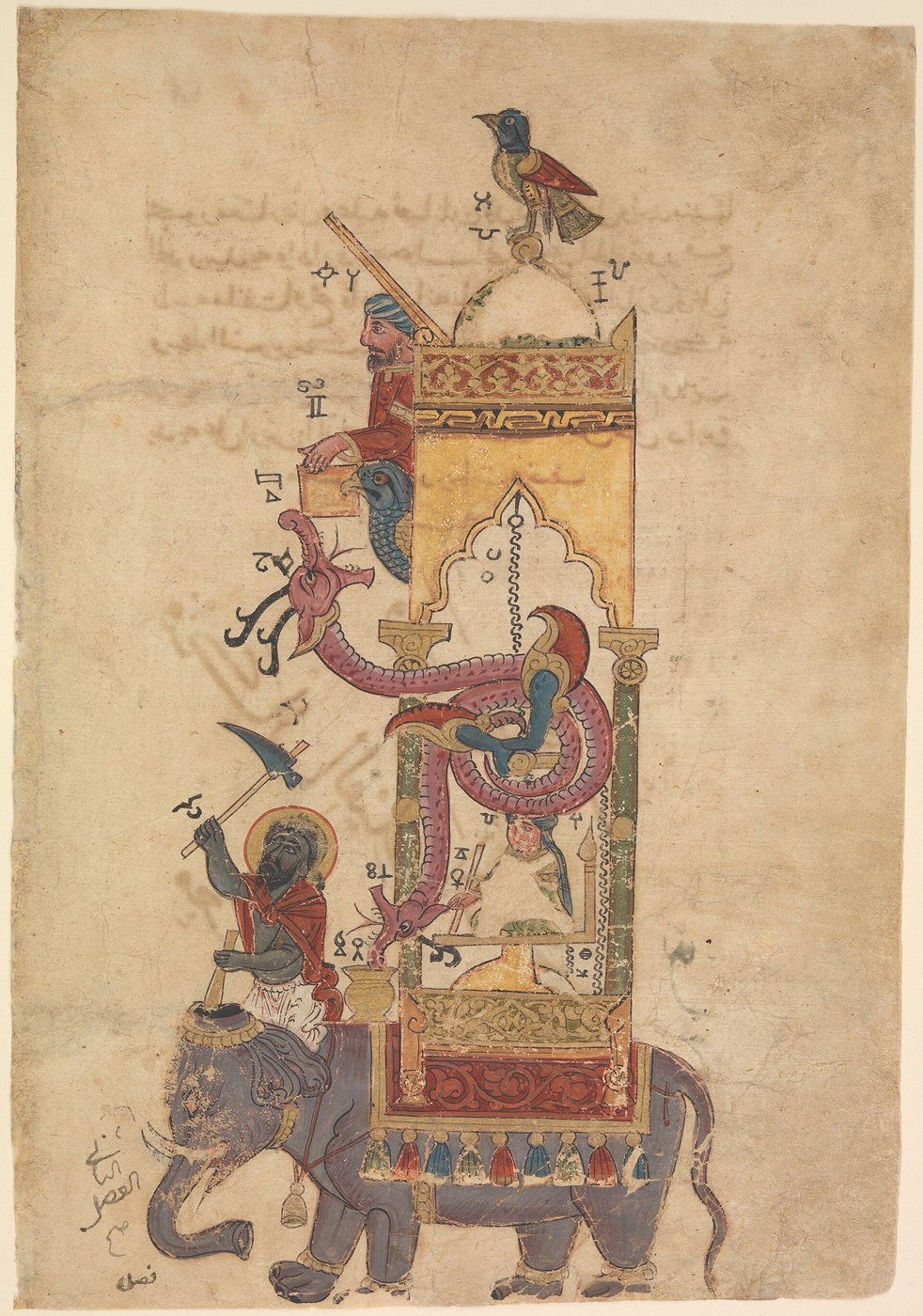
Al-Jazari is the author of the book entitled "al-Jami' bayn al-'Ilm wa'l-'Amal al-Nafi' fi Sina'at al-Hiyal" (Useful Knowledge and Applications in the Making of Devices), which gives the designs of many practical and aesthetic devices such as water clocks, automatic control devices, fountains, blood-letting vessels, combination locks and robots, and explains how they are to be made. He drew and coloured all the pictures in the work himself. This work, which has been received with great interest in the Western world since the beginning of the 20th century, was translated into English in 1974 by Donald R. Hill under the title "The Book of Knowledge of Ingenious Mechanical Devices". The famous historian of science Prof. White Jr., who wrote a preface to the translation of the book, states that many discoveries were made by al-Jazari long before Leonardo da Vinci and others. Inventions similar to the perfect devices he made using the science of cybernetics are encountered in other works only 200-350 years after al-Jazari's death.
In Western sources al-Jazari is described as "the Muslim engineer who rose to the summit of his age".
Al-Jazari's world-famous work gives information on the construction and working of automatic devices, robot elephants, peacocks that sing by themselves, automatic clocks, a robot man who pours water on the hands, and many devices related to engineering. The book gives the detailed design of 50 devices together with their drawings. Of these devices, 6 are water clocks, 4 candle clocks, 6 long-spouted jugs, 7 automatic devices producing various sounds used for entertainment, 3 automatic devices used for performing ablution, 4 blood-letting vessels, 6 fountains, 4 devices that produce sound by themselves, 5 devices for raising water, 2 locks, 1 angle-measurer, 1 boat water clock and the gate of the city of Amid. Al-Jazari also made the special parts used in these devices with great precision.
Ibn al-Baytar (1199-1248)
Ibn al-Baytar, who holds a special place in the sciences of botany, medicine and pharmacy, is known as the greatest botanist and pharmacist of the Middle Ages. He wrote a medical encyclopaedia, "Strange Plants", "A Paraphrase of Dioscorides" and the "Encyclopaedia of Medicines and Foods". During the journeys he made throughout his life Ibn al-Baytar gathered profound information about healing herbs. He collected this information in the "Encyclopaedia of Medicines and Foods", also known as the "Baytarname". In this work he dealt with the medicinal importance of a total of 1400 plants, 200 of which were previously unknown, as well as plants that could be used in place of other alternatives. Ibn al-Baytar, who in this book, written entirely with modern methods, explained which medicines could be made, arranged them in alphabetical order. He gave the equivalents of the names of the medicines in Arabic, Greek, Persian and Spanish.234 During the European Renaissance the Austrian orientalist Sontheimer translated al-Baytar's "Encyclopaedia of Medicines and Foods" into Latin. This book was used as a source in Western universities until the 19th century.
Nasir al-Din al-Tusi (1200-1273)
Nasir al-Din al-Tusi is a great mathematician who brought innovations to work on engineering and space, and who developed trigonometry by making it an independent field of science. He commented on and critically examined Euclid's 13-volume book, the "Elements".
Nasir al-Din al-Tusi and one of his manuscript works.
By solving certain engineering problems by means of algebra and certain algebraic problems by engineering methods, Nasir al-Din al-Tusi produced new systems in mathematics. In the field of mathematics he wrote books such as "The Moving Sphere", "The Unfolding of the Sphere" and "Algebra and Comparison".235 The observatory al-Tusi founded at Maragha became within a short time one of the largest and most famous observatories in the Islamic world.236 Over time it came to be accepted as one of the largest and most famous observatories in world history.
By commenting on Ptolemy's book the "Almagest", al-Tusi put forward a new and simpler theory for the universe, and with this work prepared the ground for the achievements of Copernicus. The innovations he introduced in his work on physics, engineering and space helped humanity's development in these fields. His theories and proofs have won the admiration of mathematicians in our time too. Nasir al-Din al-Tusi's book on trigonometry was translated in the Western world into Latin, French and English, and many scholars put forward new theorems on the basis of this book.
The American orientalist George Sarton said of Nasir al-Din al-Tusi: "Al-Tusi is one of the greatest Muslim scholars and mathematicians."237
Al-Qazwini (1203-1283)
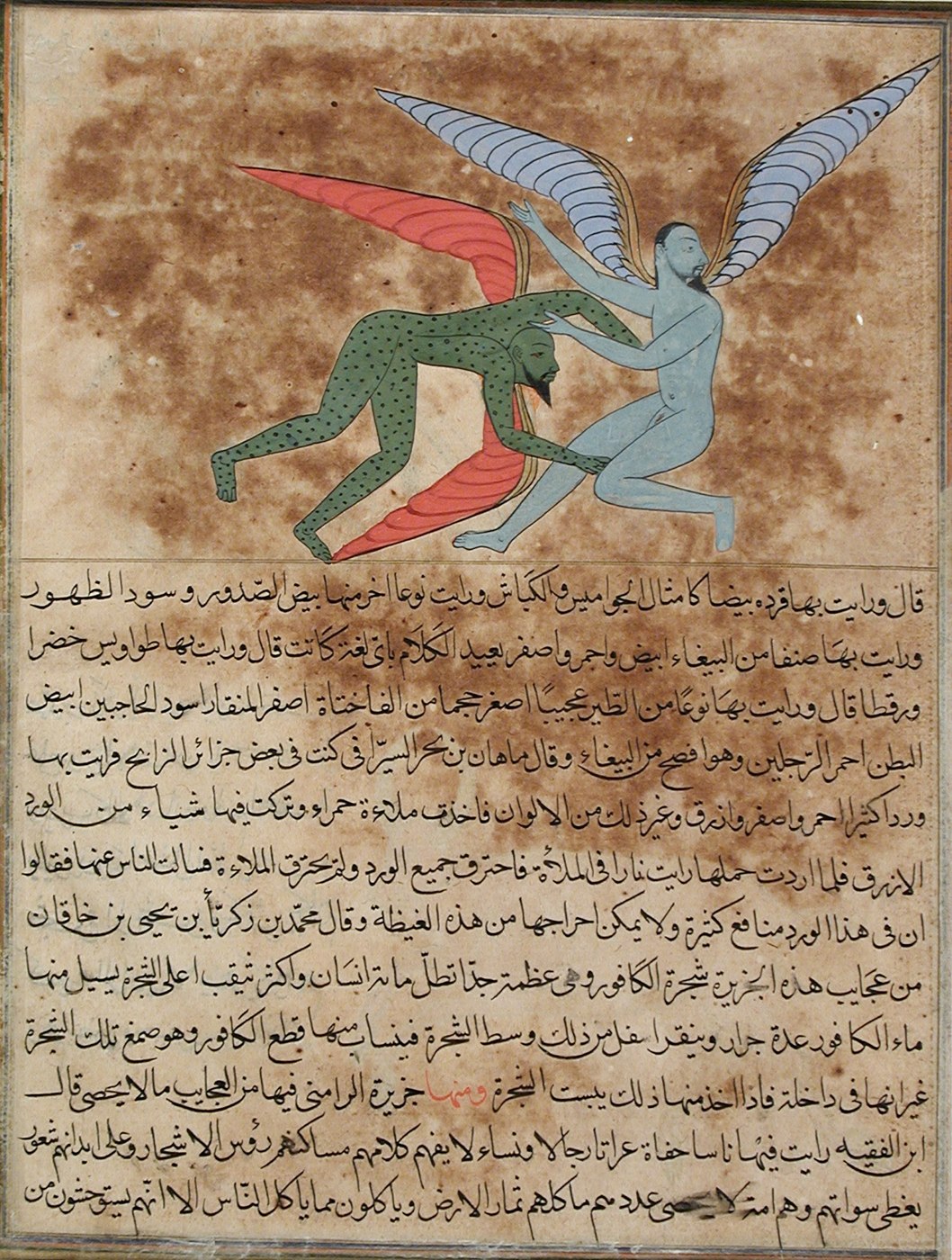
The great geographer and earth scientist Zakariya ibn Muhammad al-Qazwini, as a result of fifteen years of work, produced the book entitled "'Aja'ib al-Makhluqat wa Ghara'ib al-Mawjudat" (The Wonders of Creation and the Marvels of Existence). This book was translated into Persian, Turkish and French. The book consists of two main sections. The first section gives information about the heavenly bodies and space and deals with the positions of the heavenly bodies according to place and time. The second section speaks of basic information about the globe, the geological structure of the earth's surface, minerals, plants and animals. Al-Qazwini's cosmography, which the German researcher Carl Brockelmann called "the most valuable cosmography of Islamic civilisation", was one of the most widely read works in the Islamic world (cosmography is the branch of science that deals with the most important phenomena of cosmology, drawing only on the basic concepts of mathematics and physics).
A page from the work of Zakariya ibn Muhammad al-Qazwini.
The distinctive feature of the work entitled "'Aja'ib al-Makhluqat" is that it was written on the basis of the oneness of God and the unity of creation. The universe is the manifestation of God, the Absolute Truth. God's command "Be" ensured that everything in the universe came into being in an instant and that created living things are in mutual relationship with one another. According to Islam, man must understand the wisdom in God's creation very well. Al-Qazwini noted the importance of man striving to the highest level possible for him in order to study God's extraordinary and wise creation, reflect on it with wonder and understand it. In this way man will gain the beauties of both this world and the Hereafter.238 Al-Qazwini succeeded in revealing many truths that earlier scholars in the East and the West did not know. Many scholars engaged in the fields of space and geography made use of this book until the 16th and 17th centuries.239 Al-Qazwini's last book, "Athar al-Bilad wa Akhbar al-'Ibad" (The Monuments of the Lands and the Histories of Their Peoples), is a kind of history of humanity.
Ibn al-Nafis (1213-1288)
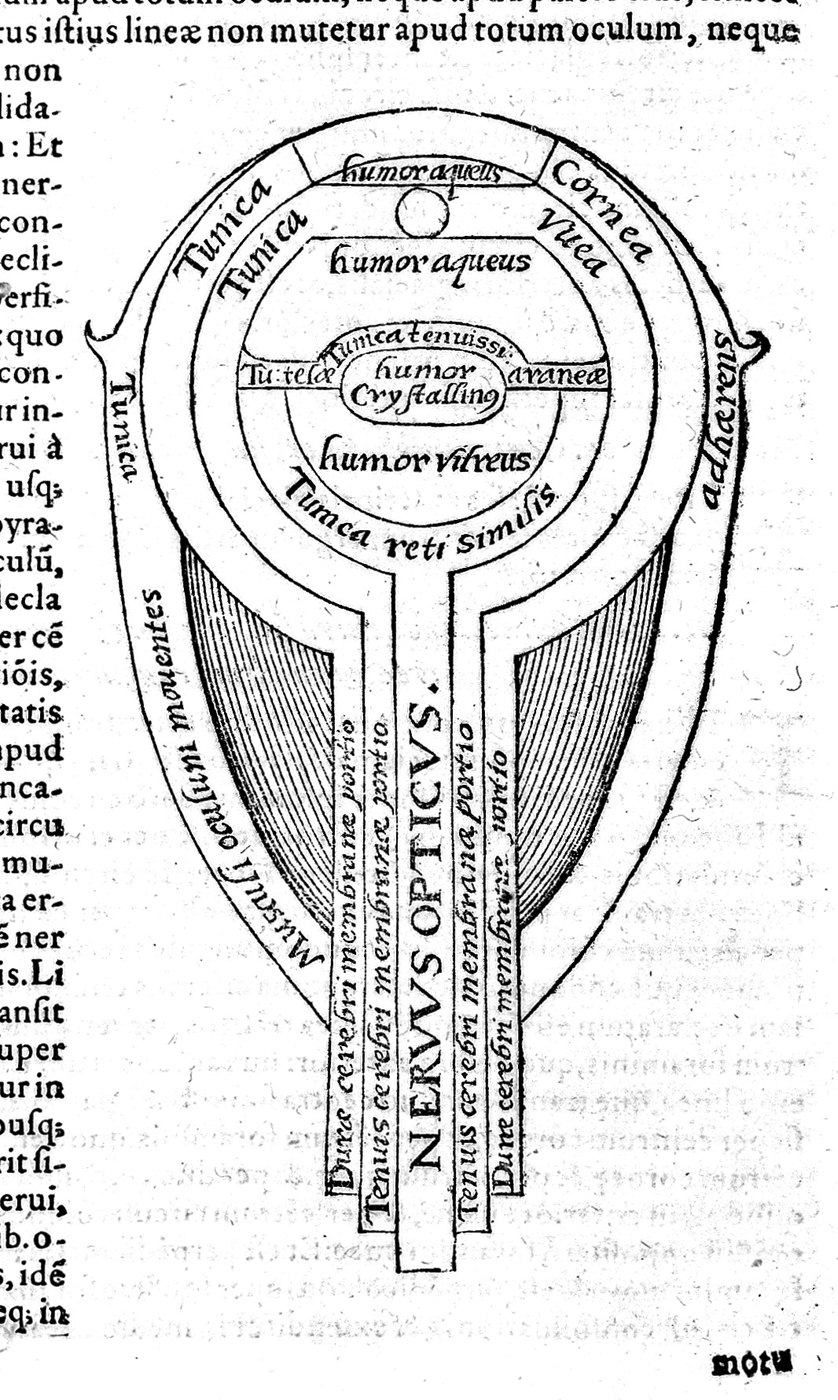
Another scholar who set his seal on important achievements in science in the 13th century is Ala al-Din Ali ibn Abi al-Hazm al-Qurashi, known by the name Ibn al-Nafis.240 In his famous work entitled "Mujaz al-Qanun", Ibn al-Nafis made many medical explanations. In his work, by studying especially the anatomy of the heart and the respiratory tract, he revealed the structure and function of the lungs and proved the existence of the capillaries.241 The most essential feature of the work is that Ibn al-Nafis described the pulmonary circulation 3 centuries before Michael Servetus in the 16th century, exactly as he did. Until that time the classical belief in anatomy held that the septum (a dividing membrane or wall separating two sections of an organ) was permeable. Ibn al-Nafis, however, put forward the idea that the septum is not permeable. Indeed, in later centuries it was proven by observation that the septum is not permeable.242 Ibn al-Nafis, without doubt, became one of the greatest figures in the history of medicine with this important discovery. In addition, Ibn al-Nafis studied the structure of the eye and the phenomenon of vision, and revealed it in a modern way.
Ibn Battuta (1303-1378)
Battuta, a great traveller, recorded in his notebook everything he experienced and saw in the places he travelled to.
Over a period of two years Battuta wrote down what he had seen on his journey to three continents. The information gathered on his travels is many times greater than that obtained on the journey of Marco Polo. 500 years after Battuta's death, orientalists began to take an interest in his travels and, translating his book into Latin, English, French and German, commented on the events.
Ibn Khaldun (1331-1406)
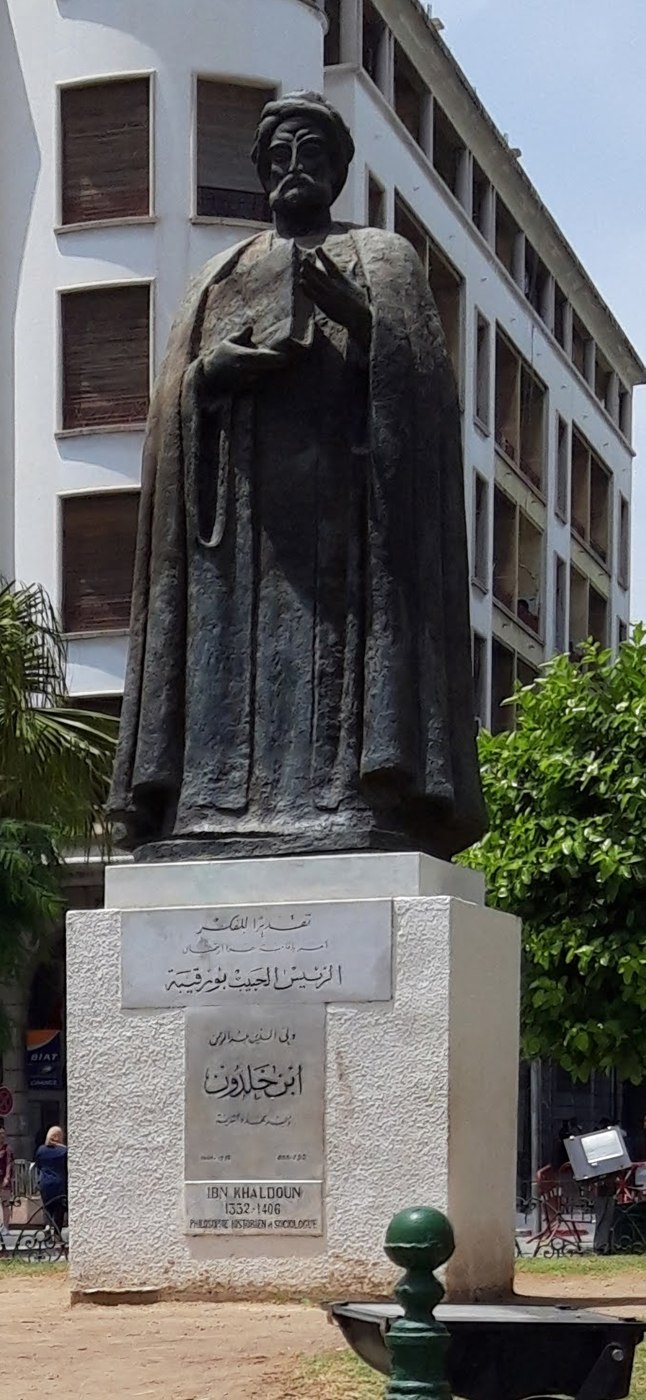
Ibn Khaldun is accepted as the founder of sociology. His work entitled "Muqaddima on the Importance of History", which he wrote, as a result of his experiences and learning, in a period as short as 5 months, became the book that laid the foundations not only of sociology but of all the social sciences.
Becoming one of the best-known books in the world on sociology, it went down in history as "The Muqaddima of Ibn Khaldun". This book deals with the social realities that influence the history of humanity.243 Ibn Khaldun, accepted as the first true "philosopher of history", was the first to base the philosophy of history on historical events.
Ibn Khaldun, known as the founder of sociology.
Qadizade al-Rumi (1337-1421)
Qadizade al-Rumi, a scholar of mathematics, astronomy and Islamic jurisprudence, was the teacher in Samarkand of Ulugh Beg, the grandson of Timur.244 Ulugh Beg too greatly valued his teacher Qadizade and had a madrasa and an observatory built for him. As a result of the observations he carried out in this observatory, Qadizade al-Rumi established that much of the information obtained by the ancient Greek scholars was wrong. He was seriously engaged in recompiling the astronomical tables. For this reason Qadizade is spoken of as the most serious and genuine astronomer of his time.
One of the most striking achievements of Qadizade al-Rumi is his calculation of the sine of 1°.245 He has important works such as "Risala fi Istikhraj Jayb Daraja Wahida" (Treatise on the Determination of the Sine of One Degree), "Sharh Ashkal al-Ta'sis" (Commentary on Ashkal al-Ta'sis) and "Mukhtasar fi'l-Hisab" (Summary of Arithmetic). Famous scholars such as Fathullah Shirvani and Ali Qushji were also students of Qadizade al-Rumi.
Mahmud Shirvani (1375-1450)
Shirvani, regarded as one of the first physicians of Ottoman medicine, wrote 11 works in his lifetime and dedicated all his works to the statesmen of his time.246 His last work, dedicated to Sultan Mehmed the Conqueror and the most important among his works, "Murshid", is known as the greatest work on eye diseases in Ottoman medicine.247 Another work he wrote, "Tuhfa-i Muradi", was included, on account of the information it contains, in the list of the first medical works written in Anatolia. Although the book in fact deals with precious stones, it is accepted by historians as a medical book because it explains the use of these stones in medicine.248 Of Shirvani's works, 4 were written in Arabic and 6 in Turkish. In early Ottoman medicine there is no second medical writer so productive.249
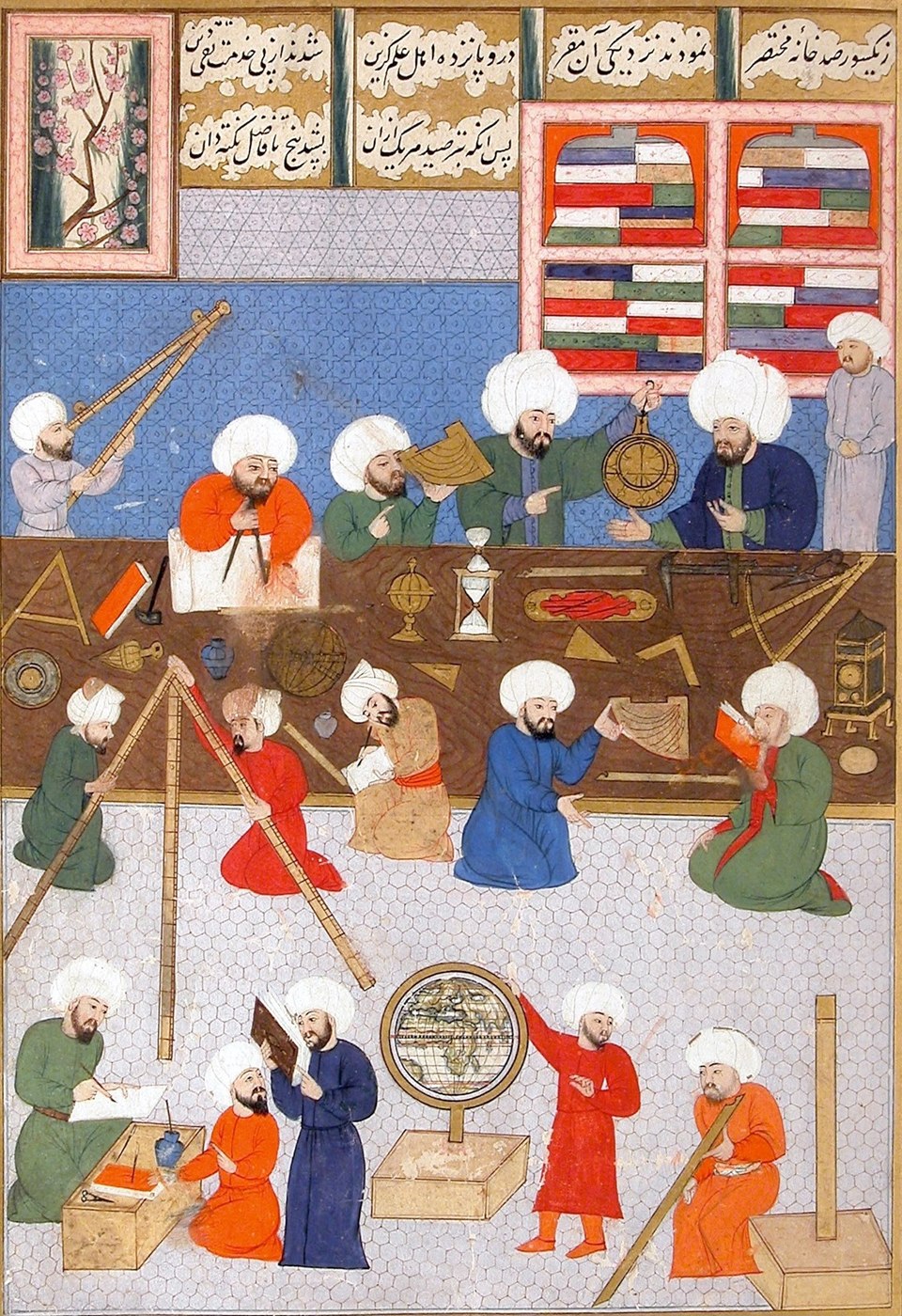
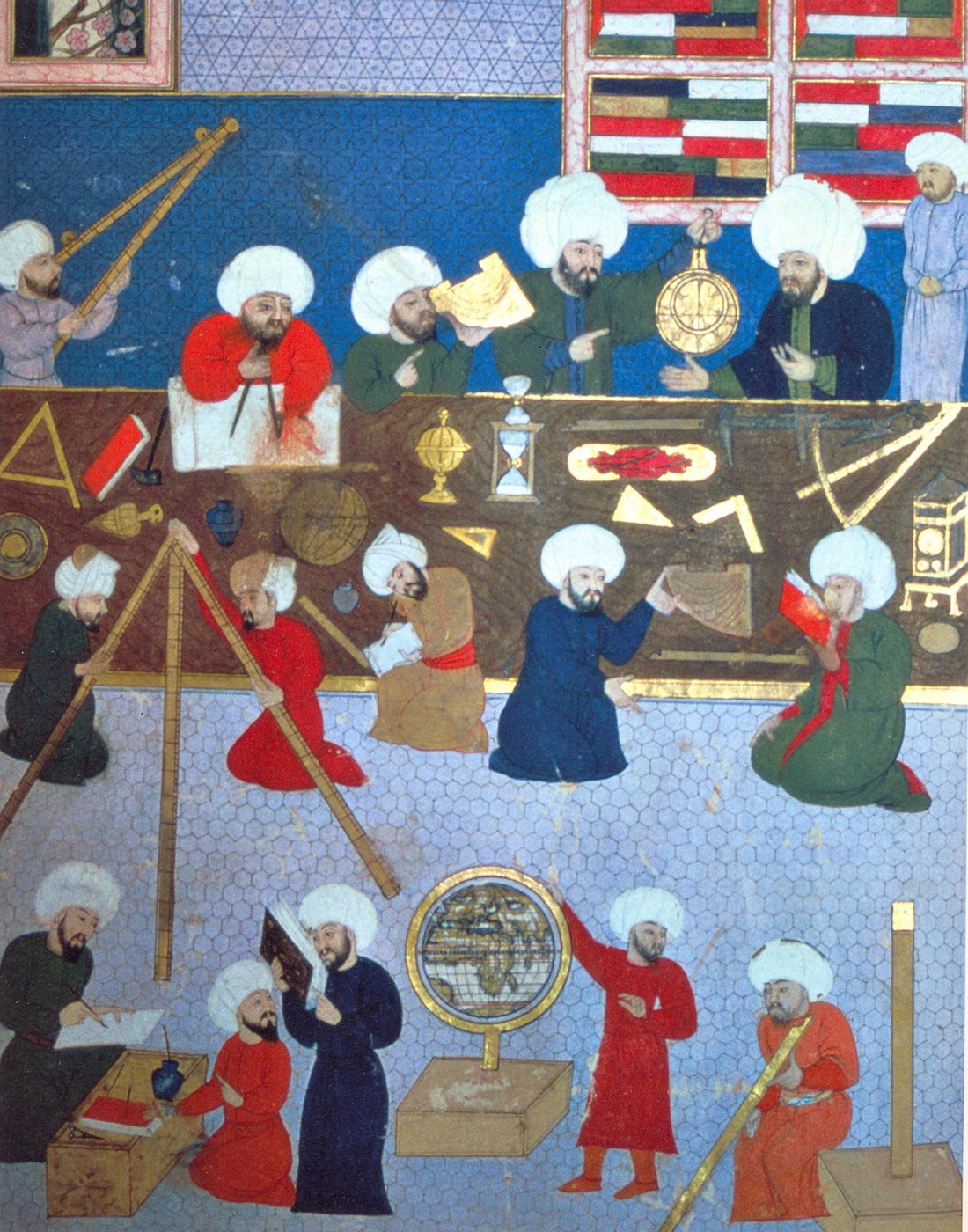
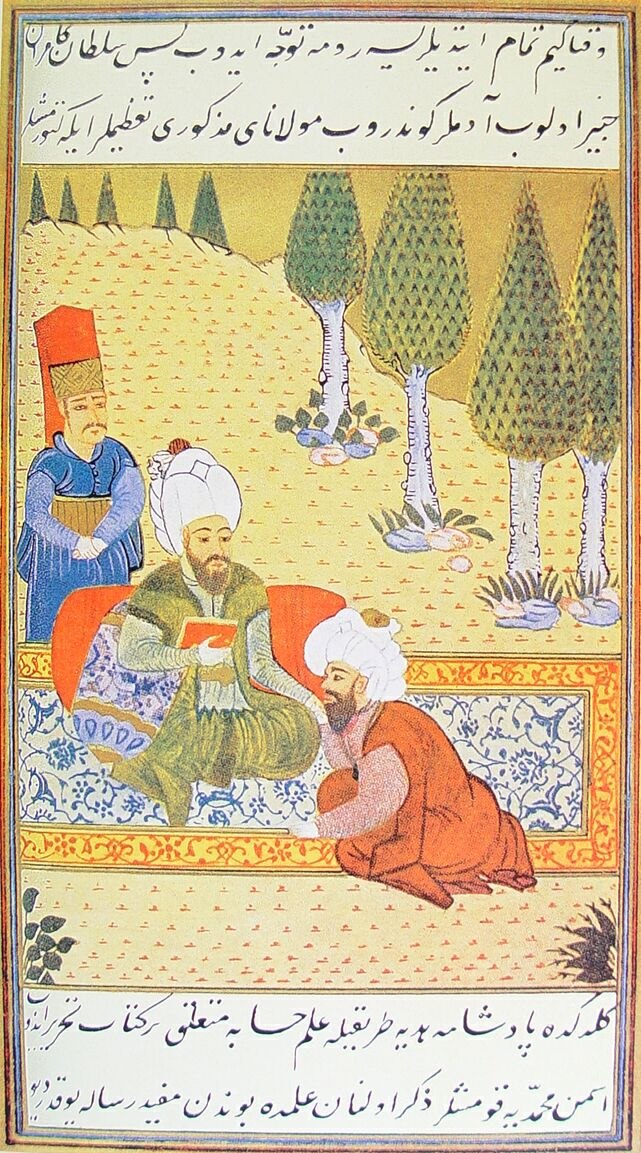
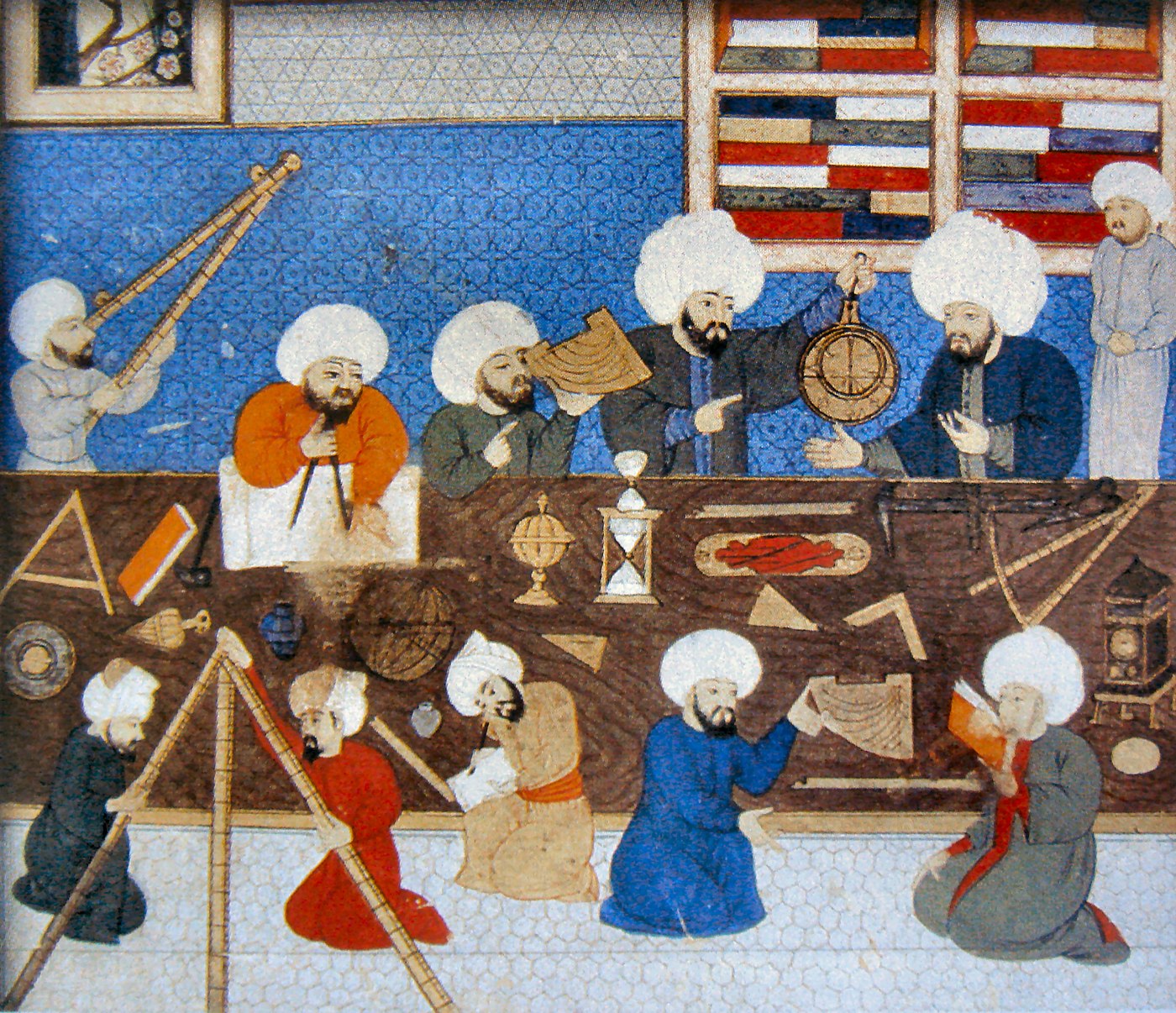
On the left is seen an Ottoman miniature from the 17th century depicting astronomical activities, and below a manuscript work kept in the archives of the Kandilli Observatory.
Sharaf al-Din Sabuncuoglu (1386-1470)
Through his works he contributed to the development of the science of medicine in the Ottoman period. "Jarrahiyat al-Khaniya", the first book on surgery written in Turkish by Sabuncuoglu, became very famous in the history of medicine because it was the first to illustrate surgical operations with miniatures.250 In his "Kitab al-Tasrif", which he wrote by improving al-Zahrawi's book, there are pictures showing, together with the instruments, how the operations were carried out. He also has a work on medicines entitled "Mujarrabname".251
Akshamsaddin (1389-1459)
He was a famous scientist of his time in such fields of science as medicine, astronomy, biology and mathematics. Among his famous works are the book on medicine he wrote in Turkish, "Maddat al-Hayat" (The Substance of Life), and the books he wrote in Arabic, "Hall-i Mushkilat" (The Solution of Difficulties) and "Risalat al-Nuriya" (Treatise of Light).252 In his work entitled Maddat al-Hayat he described the microbe five hundred years ago, saying: "It is wrong to think that diseases appear in people one by one. Diseases pass from person to person by contagion. This contagion takes place by means of seeds that are so small as to be invisible to the eye, but alive."253 Akshamsaddin, who was the first to announce to the world the conclusion that Pasteur reached with technical instruments four centuries after Akshamsaddin, also dealt with the disease of cancer.
It is known that Akshamsaddin, known for his closeness to Sultan Murad II and Mehmed II, cured many of his patients in the palace and its surroundings with the medicines he prepared. Akshamsaddin's two extremely important great medical works still preserve their importance in medical literature.
Ulugh Beg (1393-1449)
Ulugh Beg, who worked especially in the sciences of astronomy and mathematics, gave importance to scientific activity in his time despite his young age, and in 1417 had a madrasa built in order to expand activities in the field of astronomy.
Ulugh Beg, who gathered in this madrasa the most famous scientists of his time, such as al-Kashi (the Muslim mathematician who discovered decimal fractions254) and Qadizade al-Rumi, has work on precise sine and cosine tables accurate to eight decimal places and on the formulae of spherical trigonometry.
Ulugh Beg, accepted by Western scientists as "the greatest astronomer of the 15th century", worked extensively in the field of trigonometry, which formed the basis of his work in the field of astronomy, and wrote his great work, the "Zij of Ulugh Beg". "Ulugh Beg's Star Tables", the first detailed star table after Ptolemy, was the source of astronomical work until the 17th century. In this work the names and positions of 1022 stars are given. John Greaves had a part of this book printed in Oxford in 1648. Two years later the first section was printed in London; it was then published a second time and in 1665 translated into Latin. Later the work was translated in its entirety into French.255 In addition, the research at the Samarkand observatory also revealed certain errors in the calculations of Ptolemy, which until that time had been accepted as definitive.256 The facts obtained as a result of the observations at the observatory enabled Ulugh Beg to calculate the length of a year very accurately as 365 days, 5 hours, 49 minutes and 15 seconds. Ulugh Beg's other services to the world of science are the facts he obtained concerning the Sun, the Moon and the planets.257 The Western scientific world has deemed Ulugh Beg worthy of the title "the astronomer of the 15th century", and the International Astronomical Union has given his name to a crater on the surface of the Moon.258
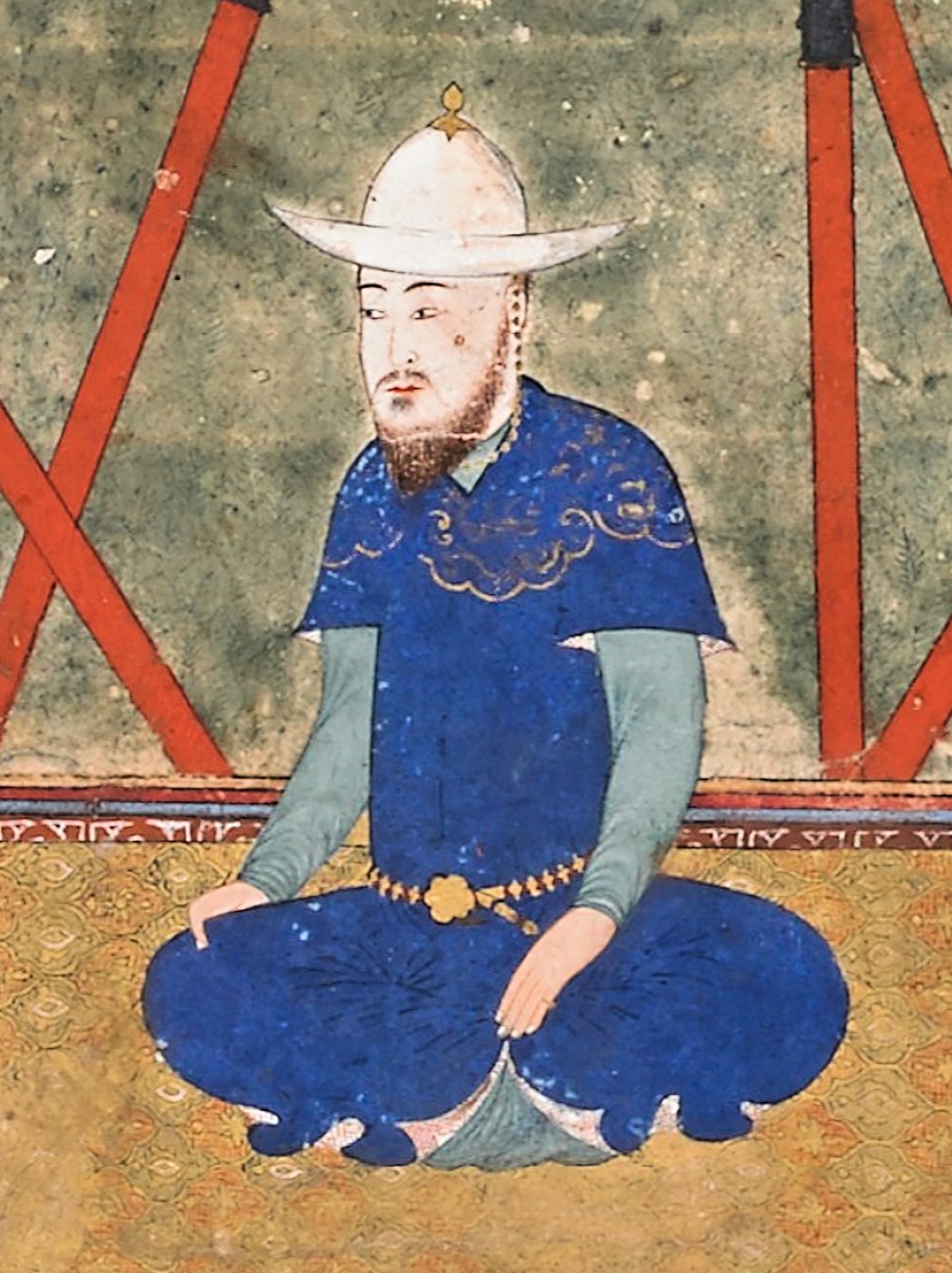
Ulugh Beg, one of the best-known astronomers of his time.
Ali Qushji (1403-1474)
Ali Qushji, who won great fame among the scholars of astronomy and mathematics of the Turkish-Islamic world through the works he produced, is accepted as one of the leading scholars of astronomy. Especially in these two fields, he carried out work in the fields of teaching and education so important as to go beyond the limits of his time.
Ali Qushji, who made a sundial at the Fatih Mosque complex, determined the degree of latitude and longitude of Istanbul.259 The name of Qushji, who compiled the first map of the Moon, has been given in our time to a region of the Moon.
One of Ali Qushji's greatest works on astronomy is "Risala fi'l-Hay'a" (Treatise on Astronomy).260 This work, which left a deep mark in the field of mathematics and astronomy, contains all the scientific details, down to the distances of the heavenly bodies from the Earth. It was written in Persian and later translated into Arabic, and even after Western science entered Turkey it remained a preferred book in the field of astronomy.
Ali Qushji, the famous Ottoman astronomer who compiled the first map of the Moon.
His great work in the field of mathematics is "Risala-i Hisab" (Treatise on Arithmetic). In addition, his work entitled "Sharh-i Zij-i Ulugh Beg" (Commentary on Ulugh Beg's Star Catalogue), which contains the most advanced mathematical knowledge of his time, won fame for its services.261 His work entitled "Risalat al-Fathiyya" was used in the 19th century as a textbook at the Istanbul Mühendishane (Istanbul Technical University). In this work he included the distances of the heavenly bodies from the Earth, and in addition he appended a map of the Earth at the end of his book. Here he determined the inclination of the axis of the globe as 23° 30' 17". This is a value very close to the modern astronomical figures of our time (23° 27').
Molla Lütfi (?-1495)
Molla Lütfi, regarded as one of the famous mathematicians of the 15th century, dealt in his book entitled "Tad'if al-Madhbah" (On Doubling the Altar Stone) with geometrical subjects such as the definitions of the square and the cube, the products of sides and faces and raising to the second power, and studied the famous Delian problem.262
Mukbilzade Mümin (15th century)
Another of the important scholars of the Ottoman period is Mukbilzade Mümin, who emerged in the reign of Murad II and wrote two important works. Mümin, together with Shirvani, who took a special interest in the subject of eye diseases, is one of the first Ottoman physicians.
The writer's first work is "Zakhira-i Muradiya", dedicated to the sultan. His second work, "Miftah al-Nur wa Khaza'in al-Surur", is likewise an important medical book dedicated to the sultan. In the book, after diagnosis and health are dealt with in general terms, details concerning eye diseases are explained.263 In this important work, detailed definitions are given of such diseases as the structure and diseases of the head and skull, eye diseases, disorders of the eyelid, conjunctivitis (inflammation of the mucous membrane of the eyelid) and inflammation of the cornea of the eye, and measures and remedies for preventing the diseases are explained.264 The fact that the name of Mukbilzade Mümin is invariably found in the lists of physicians in all the Darüşşifa (hospital) foundations of the Ottomans proves that he was an extremely important physician of his time, and at the same time reflects the attention given to eye diseases in that period.
Mirim Çelebi (?-1525)
Mirim Çelebi, whose real name was Mahmud bin Mehmed, is one of the most advanced astronomers and mathematicians of 16th-century Ottoman Turkey. He was born in Istanbul, studied in madrasas, taught during the time when Bayezid was a prince, and worked in important posts. After Ali Qushji, it was Mirim Çelebi who worked most for the development of geometry in the Ottoman period. He wrote many works on mathematics and astronomy, and his two works in Arabic, "Shifa' al-Asqam wa Dawa' al-Alam" and "Kitab al-Ta'alim fi'l-Tibb", played a great part in the development of Ottoman medicine.
One of the greatest works of Çelebi, who was the grandson of Qadizade and Ali Qushji, is the commentary he wrote in Persian on the "Zij of Ulugh Beg", entitled "Dastur al-'Amal wa Tashih al-Jadwal" (The Principle of the Work and the Correction of the Table).265 In the work the writer explained the subjects in various ways; for example, to calculate the sine of an arc of 1 degree he showed 5 different methods of solution in a very comprehensible manner.
He has many treatises on mathematics and astronomy. Mirim Çelebi is one of the Muslim scholars who worked most for the development of the sciences of astronomy and mathematics in the Ottoman state.
Seydi Ali bin Hüseyin (1498-1563)
Seydi Ali bin Hüseyin, known as Seydi Ali Reis, took part in many sea voyages, especially in wars, then served in the service of Barbarossa Hayreddin Pasha, and was a specialist in the field of astronomy and a great seaman.266 Seydi Ali Reis's most important work, showing that he was a scholar who knew marine astronomy and geography truly well, is the "Kitab al-Muhit". The work contains important subjects such as determining direction, the calculation of time, the calendar, solar and lunar times, the divisions of the compass, the heights of the pole star at various islands and famous harbours, certain information relating to astronomy, winds, routes, great storms and the measures to be taken against them. As is clear from its subjects, the "Muhit" is an extremely scientific and important work.267 Seydi Ali Reis also translated Ali Qushji's famous work "Fathiyya" under the title "Khulasat al-Hay'a" and made additions to it. In enumerating the heavens he used astronomical terms, and added that the centre of the world is the centre of the earth and that heavy bodies fall towards the centre of the earth.268 In his other work, "Mir'at al-Ka'inat", the writer gives information on such subjects as the altitude of the Sun and the positions of the stars, the determination of the qibla and of noon, finding the circumferences of circles, sines, chords and tangents, and the method of measuring the width of a river whose far side cannot be reached. He is a superior seaman and astronomer who gave much important knowledge in his field and left very valuable works after him.269
Taqi al-Din (1521-1585)
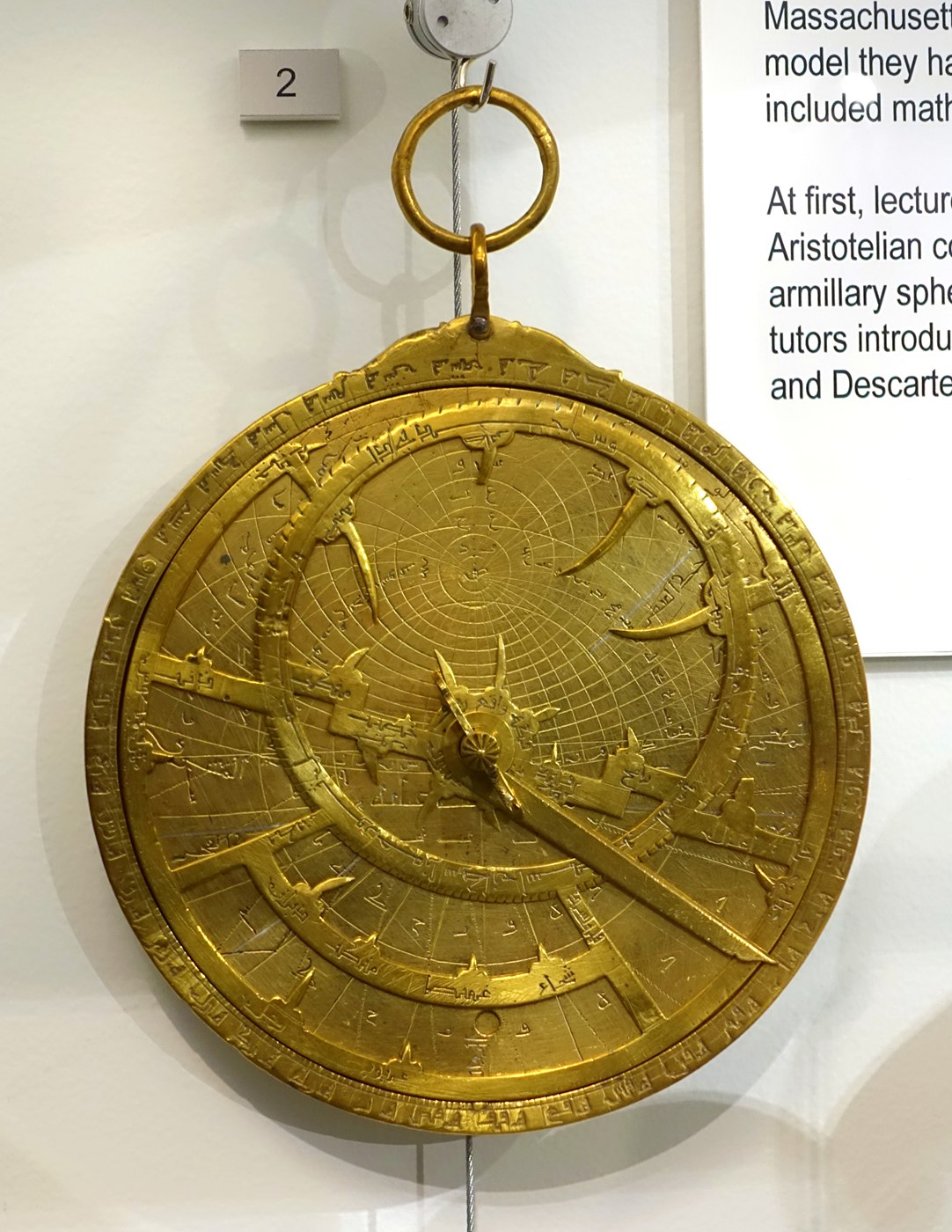
He is one of the greatest astronomers of the 16th century. He came from Cairo to Istanbul to obtain a post from the state, was introduced to the Sultan because of his mastery in the science of mathematics, and with the Sultan's great help founded an observatory. Taqi al-Din, who founded the Istanbul observatory, made nine skilful instruments that he used to carry out measurements of the heavenly bodies, and these were the most perfect observational devices of the 16th century. One of these devices, the "libna", is a mural instrument used for observing the passage of the stars across the meridian. With this instrument it became possible at that time to calculate the equatorial coordinates of the heavenly bodies.
Taqi al-Din's most important work is "Sidrat al-Muntaha". In this work the parameters of the Sun were calculated using the method of three observation points. Taqi al-Din is the third person in the world, apart from Tycho Brahe and Copernicus, to use this method. Although they reached similar results, Taqi al-Din's calculations concerning the parameters of the Sun went down in history as the most accurate calculations of the 16th century.
In his works Taqi al-Din spoke of "clocks" as astronomical instruments.271 The most essential feature of these clocks is that they calculate minutes and seconds precisely. The date of the making of a clock showing minutes and seconds in Europe coincides with the same period in which Taqi al-Din spoke of this mechanism.
In a small zij entitled "Kharidat al-Durar wa Faridat al-Fikar" (The Collection of Pearls and the Pearl of Ideas), Taqi al-Din used decimal fractions and gave information about them. In other words, long before decimal fractions became known to Europe, they had not only been introduced by Taqi al-Din but even used.272 Taqi al-Din's work in the field of optics also formed the basic knowledge of the science of optics. The high level he reached in the science of optics ran parallel to debates that remained current in the West until the 17th century.273 Taking all this into account, it is clearly seen that Taqi al-Din is one of the scholars who achieved "firsts" in the world.
Katip Çelebi (1609-1657)
Katip Çelebi of Istanbul both engaged in science and gave private lessons to the children of statesmen. The works of Katip Çelebi, who knew Arabic, Persian and Latin, were translated into many foreign languages. His most important work, "Kashf al-Zunun", is a bibliographical dictionary listing one by one 14,500 works by 10,000 Islamic writers. "Cihannüma", the most important of the geography books written in Turkish, "Fezleke", a very valuable book of Ottoman history, "Tuhfat al-Kibar", reflecting the history of Turkish-Ottoman seafaring, and "Taqwim al-Tawarikh", which deals with world history, are among his very famous works.274 In his work on geography and astronomy entitled "Cihannüma", he divided the 5 continents of the Earth into 6 regions and gave general information about each of them (Europe, Asia, America, Australia and the Polar regions). In the work various proofs are given that the Earth is spherical, and information is given about all the plants and animals known from Japan to Erzurum. "Cihannüma" is at the same time the first and only systematic geography book containing valuable information, found nowhere else, about the dominion of the Ottomans on three continents and their cities and towns.275
Hezarfen Ahmed Çelebi (17th century)
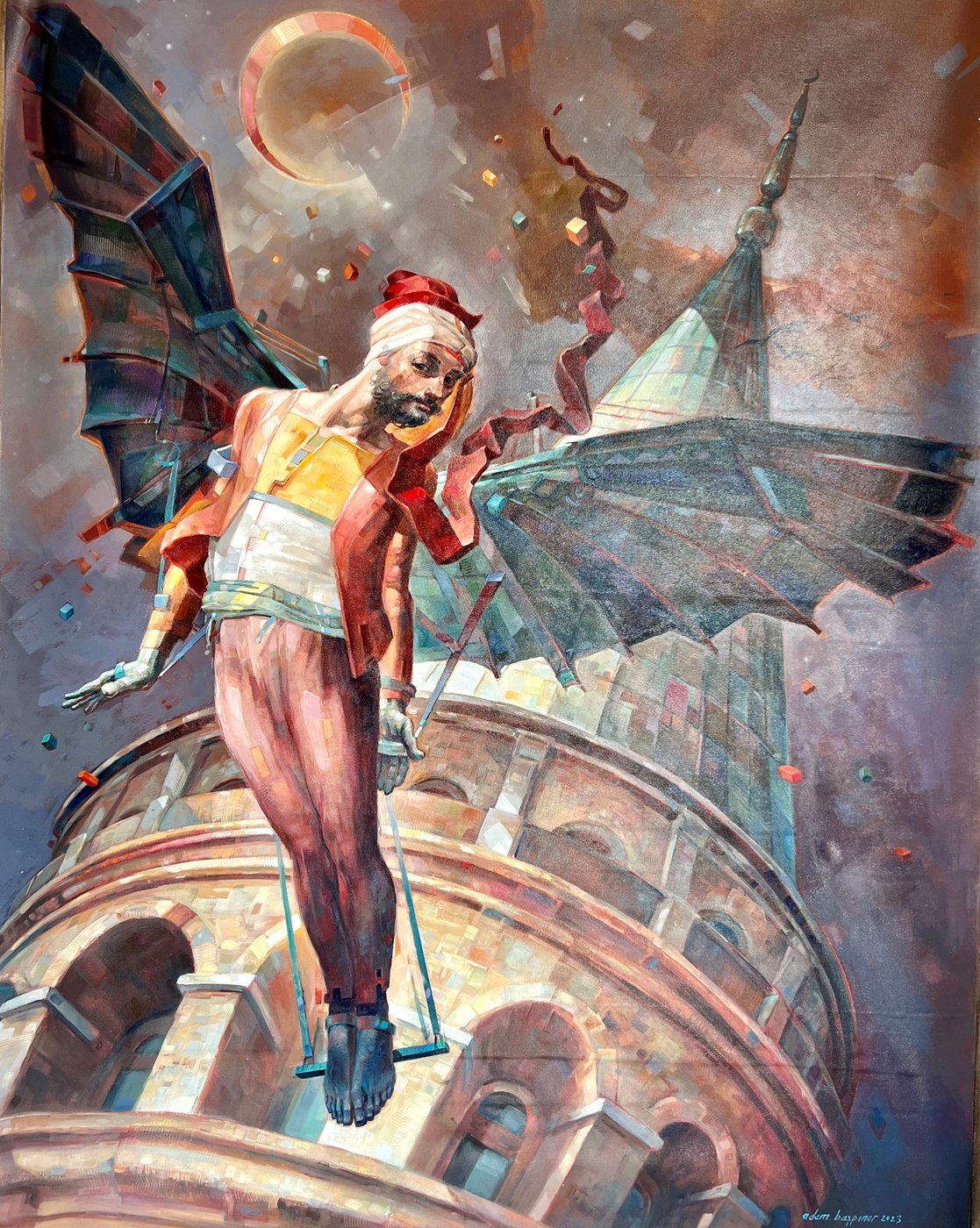
Ahmed Çelebi, who, in order to measure the durability of the wings he had prepared by studying the flight of birds, launched himself into the air from the Galata Tower and moved his wings, crossed the Bosphorus and landed on the Üsküdar side. Because he was one of the first people to succeed in flying with wings he had made himself, and because of his comprehensive knowledge, he is known among the people by the nickname "Hezarfen", meaning "1000 sciences".
Hezarfen Ahmed Çelebi prepared a simple form of today's means of air transport and became one of the important figures of the history of Turkish aeronautics.276
Conclusion
The common characteristic of the Muslim scientists whose valuable work in the scientific field we have discussed in this section is that they studied the evidence of the infinite knowledge of our Lord Most High and strove to comprehend His might better. These scientists, only some of whom we have been able to include, did not content themselves with scientific activity alone; as they saw the evidence in the universe their fear of God increased, and they continued their efforts with great enthusiasm to make the absolute existence of God known to people. The Muslim pioneers of science, while proving the magnificent mechanisms created by our Lord Most High, also aimed at doing away with the false religions that deify nature (we exalt God above this). They studied the information in the verses of the Qur'an and used science correctly to discover their secrets. Taking as their example the fact that the Qur'an leads the way to science, they presented to all people the scientific findings they obtained as a result of this research. The leadership of the Muslim scientists should be an example to all Muslims in our time. This will help all people to know widely the evidence of our Lord's creation and, God willing, will contribute to positive progress in the spread of the moral values of religion.
The common characteristic of Muslim scientists is that they strove to study what God has created and to present His infinite power, might and knowledge to people.